More Museum Sketching

I’m settling into a winter sketching regime which means I’m becoming a regular at Quebec’s Musee de la Civilisation  again.   I made over 50 museum visits last year and it’s likely I’ll do the same this year.  This day, I was with my new buddy, Fernande and we had a good time sketching in the Paris exhibition.  We followed up with a celebratory tea in Cafe 47, the museum cafeteria.

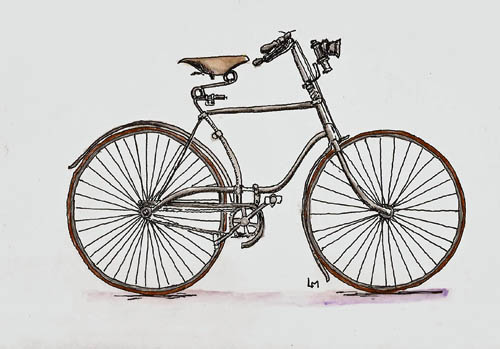
I nearly went cross-eyed trying to do a ‘proper’ drawing of this Delizy Brassart bicycle, which dates to 1889.  I was particularly interested in getting the frame organization ‘right’ as it’s very unique, with the crank being bolted on below the actual bicycle frame instead of being an integral part of it.  The solid rubber tires and carbide light are also very interesting.  Bicycling was a big deal at the turn of the century, with many innovations, the first Tour de France, and women wore bloomers so they could ride, showing off their ankles.  Ooo la la!
Stillman & Birn Zeta (6x9), TWSBI Mini with Platinum Carbon Black ink

Stillman & Birn Zeta (6×9) sketchbook, TWSBI Mini with Platinum Carbon Black ink

I thought I should draw something a bit easier after that so I chose this vase with stopper.  Pretty little thing and, I fear, I didn’t do it justice.  I used a Uniball UM-151 brown-black pen to do the brown markings on the vase, which worked better than I thought it would.

Stillman & Birn Zeta (6x9) sketchbook, TWSBI Mini w/Platinum Carbon Black ink

Stillman & Birn Zeta (6×9) sketchbook, TWSBI Mini w/Platinum Carbon Black ink

One thing about museum visits is that they challenge me to draw things I might not otherwise draw.  It really helps and there’s nothing better than a museum atmosphere to stimulate the creative neurons.

 

My First “Painting”

If you follow my posts you know that I’m a pen driver.  I draw a bunch of lines, hope they look like something and then, if I want to add color, I generally just ‘fill in’ the various pieces, using watercolors like crayons.

But I thought it was time to do a “painting.”  I’m not really sure when a sketch becomes a painting or whether you have to approach things very differently to create a painting.  Seems to me like it’s more the later than former so that’s what I did….that different thing.

We’d just gotten some snow and I was out walking, saw a “winter scene” to my liking and took a quick snapshot of it.  When I got home I took a 5×7 sheet of Fabriano Artistico “Extra White” cold press paper, and I made a few marks to indicate a horizon and the verticals for my fire hydrant.  Ya gotta have fire hydrants in paintings don’t you?  I do.

2013-11-27Hydrant_72Then, with considerable intrepidation, I started applying paint roughing out the tree and hydrant in light color.  Once I knew their ultimate shape I increased the color until it was mostly as you see it here.  Then I added a bit of ink just to emphasize things a bit.  I don’t know if this is an example of my demonstrating a willingness to learn new tricks or that I have no shame in posting my first painting.  Either way, here it is.


Drink And Sketch, Drink And Sketch

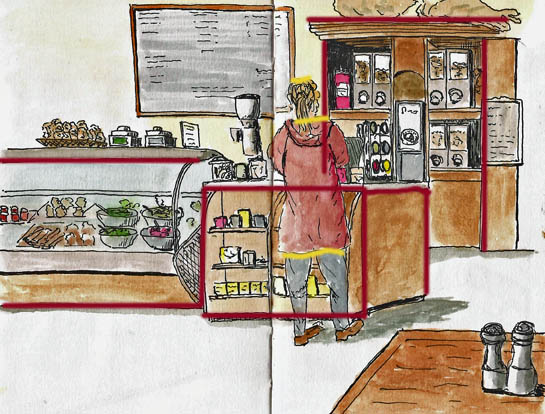
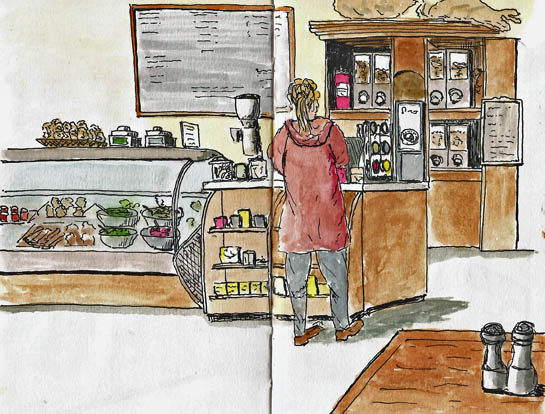
On my way back from a discussion with a bank manager I stopped into a place for a cup of tea and the possibility of sketching an interior scene.  It wasn’t the Taj Mahal but what the heck, it was great practice.  Here’s the result, done in a Stillman & Birn (4×6) Alpha sketchbook.  I used a TWSBI Mini as my pointy device.

2013-11-20PicardieSillery_72

While the counters, coffee and tea didn’t move, the people did as one after the other, a person came to the counter, paid for something, and left.  I’ve been asked several times about how I set up a sketch like this and I thought it might be time to oblige.

It’s fashionable in internet-land to proudly state that one doesn’t use pencil.  Ink is the only way to go.  Well, I’m an ink guy and most of my sketching is done in ink.  But I’ve also learned that laying down a few bones beforehand allows me to concentrate on the drawing of each section of a sketch and prevents my ideas from running off the page.

2013-11-20PicardieSillery_layourSo, I start with a pencil, a 3H pencil to be exact.  I draw lines to represent the major vertical and horizontal components.  I’ve indicated the pencil work for this sketch in red.  Once done, I can look at the paper space and compare it to the scene, ensuring that things are going in the right direction.  Note how few lines are actually required.  This is not drawing; it’s organization.

In this case I also wanted to place a person and I could use counter height and the verticals to locate her.  I’ve indicated three small pencil lines in yellow that define the top of her head, her shoulders as well as the bottom of ‘her’ coat.  The reality is that the coat was drawn mostly from the first customer but also the second, who contributed the legs/shoes.  A third provided the head, but as I had these little lines in place, it was easy to cobble together a person for my scene.  Given how light the pencil lines are, I rarely see a need to erase them when I finish so no eraser was harmed in the creation of this sketch.

Could I do this with dots from a pen?  Sure.  When I did Brenda Swenson’s 75-Day Challenge (limits you to ink only) that’s exactly what I did.  But it’s far easier to see the scene structure with some lines than with a few dots and a .5mm pencil isn’t that heavy so I carry one for this purpose.  Besides, if layout underpinnings was good enough for the master artists of the 18th and 19th Century, why shouldn’t it be good enough for me (grin)?

2013-11-21Brulerie3rdAve_72The next day I was meeting a friend for tea at one of my favorite haunts and this guy, all scrunched down in his chair caught my eye.  I sketched him and then just kept going, ending up with this scene.

Sketching The Past

Winter sketching, as I’m mentioned before, is confined my sketching to indoor venues.  That’s ok because there are museums, coffee shops, and librarys to provide sketching opportunities.  But what’s a guy supposed to do when he’s sitting at home and wants to draw?

Photos?  I’m not very good at drawing from photos as I don’t feel I can ‘see’ the same as when I’m actually on location.  It’s also not as much fun for me.  But that’s the choice that Mother Nature gives me so what the heck…photos it is.

What photos, though?  I’ve taken a lot of photos of Quebec City with the thought of using them as sketching material but it’s occurred to me that there may be better alternatives.  Why not sketch stuff I can’t see any more?  Dirigibles, Victorian hats, inkwells, carrier pigeons or steamships?  Or trains….that’s it…trains.

Our society decided we’d subsidize the trucking industry in the 50s and 60s by building a highway system which allowed that industry to outcompete the railroads, that had to maintain their own ‘roads.’   So, now we’ve got LOTS of trucks to draw, lots of trucks burning fuel, and the warehouses of our world have become 18-wheel diesel-powered boxes clogging up our highways.  Oh and we have far fewer trains.  So yeah, I could draw trains.

And what better place to start than with the lowly caboose.  As a kid, train watching was a big deal.  We’d wave at the engineer as the engine went by, hoping he’d blow the whistle for us.  Then we’d wait…and wait and finally, after a bunch of boxcars, tankcars, and hopper cars, here it would come…the CABOOSE…the crummy, the brain box, the dog house…whatever you called it – it was RED!  They were mostly eliminated from trains in the 1980s, replaced by “EOTs” (End Of Train device) which are boring boxes of electronics and a red light that get hung on the end of the train.  Kids don’t watch trains any more and I don’t blame them.  My daughter didn’t even know what a caboose was when I showed her my sketch.

Stillman & Birn Alpha (9x6) sketchbook, Pilot Prera, Lex Gray ink.

Stillman & Birn Alpha (9×6) sketchbook, Pilot Prera, Lex Gray ink.

I sketched this one from a black and white photo in a book I own.  It was fun.  My daughter learned what a caboose was.  Maybe I’ll draw some other things she has never seen.

Sketching a Mutoscope

I met Fernande at the Musée de la Civilisation on Saturday morning for a sketching session.  We’re having so much fun with these weekly meetings.   I like sketching by myself.  I love sketching with someone else.  Besides, the tea and sketching talk that follows our sketching is priceless.  The museum exhibit, “Paris on Stage, 1899-1914”, holds a lot of potential for sketchers, if you keep an open mind about your subject matter.  On this day I decided to sketch a “mutoscope.”

george-meliesLong before a short film of a train arriving in a station scared the be-geezus out of people who were seeing their first “moving picture” and before George Méliès shot the moon with a large bullet full of people, there was the mutoscope.

Early ‘moving pictures’ were created not by a long piece of multi-framed film but rather by a whole bunch of pictures, shown in rapid sequence to the viewer.  As kids we’ve all played with ‘flip books’ that did the same thing.  A sophisticated version of this approach was the mutoscope, a device that held, by my guess, about a gazillion and one sequenced pictures in a large, round canister.  You deposit a coin, look through a viewer,  turn the crank, and watch the movie.  Of course, to entice people to do just that, these machines were well-decorated, providing a really time-consuming subject for a sketcher like myself.  I tried to simplify it but it still took forever to draw all the scrollwork.  Lots of fun, though.  I did this in a Stillman & Birn Zeta (6×9) sketchbook, with a TWSBI Mini pen filled with Platinum Carbon Black ink.

2013-11-22Mutoscope_72What do you mean you don’t know who George Méliès is?  He almost invented the genre of action films (grin).   Go to Netflix or your favorite video store and rent Hugo, in which George plays a significant role.  And keep your pause button handy as there’s lots of great stuff to sketch in that movie 🙂