The Best Way To Fish

  ssds

Many men go fishing all of their lives without knowing that it is not fish they are after. – Henry David Thoreau

There was a time in my life when I was an avid fly fisherman.  I have to disagree with Thoreau.  Most of us fished knew exactly why we were doing it and that catching fish was way down the list of reasons we did it.  I certainly knew why I’d gone “fishing” today and without catching a single one, I got exactly what I was after.

I woke to falling snow.  Yep…the end of March and it was snowing. So I whined a bit into my morning coffee and made a decision.  I would go sketching at Quebec City’s aquarium.  As it turned out, it snowed all day but I didn’t care.  I spent the entire morning at the aquarium and it was wonderful because aside from the people who worked there, the place was nearly empty and I wandered around watching the fish and doing some sketching of them.

Stillman & Birn Gamma (10x7), Namiki Falcon, De Atramentis Document Black

Stillman & Birn Gamma (10×7), Namiki Falcon, De Atramentis Document Black

Still Looking At Snow…Lots Of Snow

There are hints that we may be starting to slide towards warmer temperatures but unless 34F is warm to you, they’re not here yet.  And I’m getting desperate.  I sit at home, trying to get a mental picture of what I might see if I were looking out windows from various places I can access around town.

And so it was as I hopped a bus and headed to rue Cartier, a classic shopping/restaurant street.   At the end of a small indoor shopping complex is one of the best burger restaurants in town.  They make real burgers with lots of imaginative toppings.  And they have tables, next to windows, that look out on what is a large garden area associated with a historic house.  I knew I could see something to draw from one of those windows, though the garden itself would be completely covered in snow.

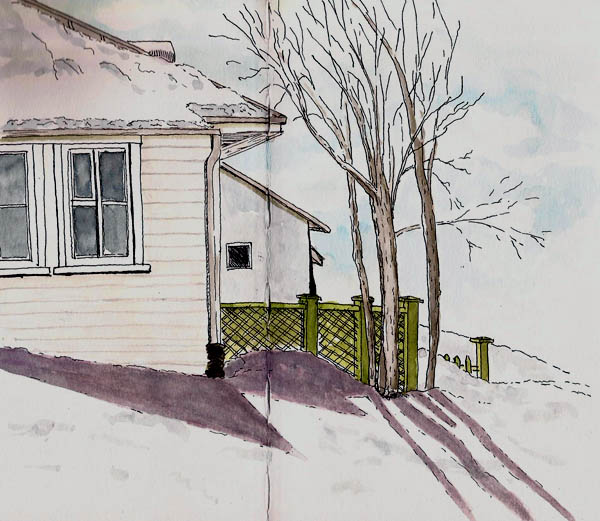
Here’s what I came up with.  Lots of snow, which is the common state of all scenes in Quebec City right now, but I was in a warm building, sitting in the sun, and I was sketching.  What more could a guy want.

2015-03-27houseThis was done in a Stillman & Birn Beta (6×9) sketchbook using a Namiki Falcon (alias Pilot Falcon, which some are now calling a Pilot Elabo), and De Atramentis Document Black ink.   With any luck at all, spring may arrive before the summer solstice.

Sketching A Hansom Cab

space

A minute later we were both in a hansom, driving furiously for the Brixton Road. – A Study in Scarlet 

I’m a big fan of Sherlock Holmes.  Not the Robert Downey Jr. Sherlock.  Not the TV show Sherlocks.  I’m a fan of the original, as written by Arthur Conan-Doyle.  In those stories, Holmes and Watson were often travelling in hansom cabs.

Sherlock’s carriage equivalent of the taxi was, more precisely, the Hansom safety cab, designed by architect Joseph Hansom in 1834.  It’s interesting to note that “cab” is short for cabriolet, a French word for a 2-wheel, horse-drawn carriage.  It’s also where taxi cab comes from.

I’d never actually seen one until Quebec City’s Musée de la civilisation opened an exhibit of 13 representatives from a large collection of carriages.  I had to draw it.

I did this one in a Stillman & Birn Gamma (10×7) sketchbook.  It was the first sketch in my new, “Spring” sketchbook.  I hope you like it.

Stillman & Birn Gamma (10x7), Namiki Falcon w/De Atramentis Document Black

Stillman & Birn Gamma (10×7), Namiki Falcon w/De Atramentis Document Black

Making A Small Sketching Binder

This is actually a follow up post from my last about sketching in small notebooks.  It’s the case that I kinda-sorta glossed over how to construct the binder I talked about.  Maybe I should do it more often as I got emails from a few nice people asking me questions about it.

So here is an explanation of how to make that small binder.  Clicking on the photos will enlarge them.  While the binder I showed was made from thin mahogany sheet, I’m going to illustrated the method using a couple matboard scraps.

gaffer's tape & materialsThe most popular question I got was “what is gaffer’s tape?”  If, as Red Green says, duct tape is the handyman’s secret weapon, gaffer’s tape is a modelbuilder’s friend.  My bet is that gaffers use it too.

It’s black.  It’s a fabric tape that comes in several widths.  It’s about as sticky as duct tape and it cuts cleanly.  Here it is, with two, notepad-sized pieces of mat board ready to be taped together.

The key to a successful binder is placing the two cover pieces up against one another as in the photo.  The outside surfaces should be facing downward.  In this way, when the book is opened, the two cover edges will butt up against one another, providing a built-in limit for the hinge and a stiff, single surface, just as when you open a game board.

inner binding

Cut a strip of tape that’s longer than the height of your covers.  I actually attach the tape to the table top just above the covers.  This allows me to hold the two covers together as I pull the tape down across their interface.  Use a razor blade to cut the ends of this tape flush with the cover surface.  DO NOT wrap the tape around to the other side or the hinge won’t work.
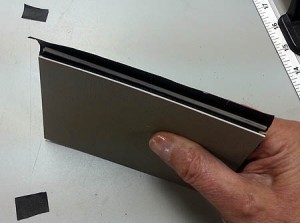
outerbinding

Insert one of your notebooks between the covers and squeeze this sandwich together.  Place a piece of tape along the face of one cover and, maintaining pressure on your sandwich, roll the tape over the hinge point to the other cover, smoothing out the tape on the back cover.
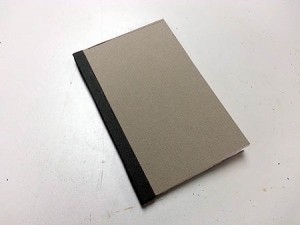
Finished_book

Voila, you’ve got a binder. You’re on your own for rounding the outer corners.  I just used a disk sander on my wooden one but it would be easy enough to cut them.

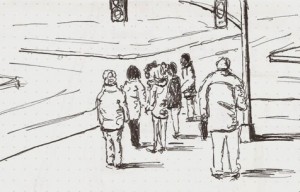
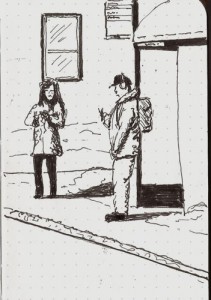
Now all you’ve got to do is find a notebook that is happy with whatever pointy device you use.  I mentioned last time that neither the Baron Fig or Field Notes notebooks are happy with fountain pen inks, though if you use Microns, Sharpie pens (not markers) or ballpoints, you’ll have good luck, with the potential for a bit of ghosting.  With fountain pens, however, or even using Micron/Sharpies to fill in an area with a dark field of ink, you’ll experience bleed through, potentially ruining the backside of the page.  I thought I’d share some of the tests I’ve done.  Keep in mind these are 3×5 sketches.
2015-03-23sketches1

Here are two quick sketches I did of people waiting for the bus.  The one on the left wasn’t too bad.  There was a tiny amount of bleedthrough from one of the dark heads.  For the second one, however, you see that I filled in some areas using the Sharpie Pen and most of those areas showed significant bleedthrough that would prevent drawing on the backside of the page.
2015-03-23sketches2

2015-03-21skaterThe last example I’ll show you is this skater.  He was on a poster advertising a crazy event they have here called Crashed Ice, where skaters race down a curvy downhill course, complete with jumps and, well..more than a little bit of crashed ice.  You can see a bit of ghosting from the previous page but I don’t find that objectionable for this purpose.  This experiment is interesting because there was no bleed through.  All of the pen work was done using my Pilot Falcon (fine) and De Atramentis Document Black ink.  I expected some bleed through in the cross-hatched areas but I didn’t get any, probably because I didn’t let the pen stop moving.  So I went one step further.  I did some shading with a Tombow water-based brush pen.  I’ve found that water-based brush pens (the brands I’ve used) don’t penetrate the way most solvent-based brush pens do (the brands I’ve used) and I was pleasantly surprised that the Tombow worked just fine in the Field Notes book.

In the end, I’d sure like to find a 70-80# paper staple-bound notebook that would eliminate the bleedthrough problem.  I’m still on the hunt.  In any case, I hope I’ve answered the questions about creating the binder.



Sketching In Small Notebooks

It’s officially spring in the northern hemisphere.  I wonder.  In Quebec City, it snowed last night and it’s currently -17C with the wind chill dragging it down to -27C.  Is that REALLY spring?  I don’t think so.  I’m staying inside today and thought I’d begin the day with a blog post.

I’ve been on a quest ever since I took Marc Taro Holme’s online course, People in Motion.  During that course he introduced the use of a “scribbler” – a small notebook in which you are supposed to draw constantly.  The idea of a small notebook for all the time drawing was not new to me.  Yvan Breton got me doing that a couple years ago.  I’ve been using notebooks that I bought at the dollar store.

What sent me on my quest was Marc’s use of a Moleskine “Cahier” as his scribbler.  These are very thin, staple-bound notepads, much thinner and lighter than my notebooks.  Of course I had to try it.

And I didn’t like it.  There were a number of reasons.  Like my notebooks, there are problems of ghosting and bleed-through but, while it can be annoying, for the purposes of capturing scenes and people quickly, it’s a mnor problem.  They don’t take color well either.  But the real reason I didn’t like them was that they are floppy.  I need all the help I can get when I put pen to paper and a hardcover backing is important in that respect.

But I couldn’t get the idea out of my head.  I reported on Baron Fig notepads as I investigated this further and I’ve filled one of them.  As a post-review follow up, I found the covers to be a bit fragile for someone shoving these books into his coat pocket.  Paper is nicer than the Moleskine, however.

2015-03-21Sharpie_book

Lately I’ve been drawing in a Field Notes notepad.  These have the virtue of being beautiful.  They release new colors and styles all the time, but the base idea is a 3×5 book with decent writing paper… as long as you don’t use fountain pens.

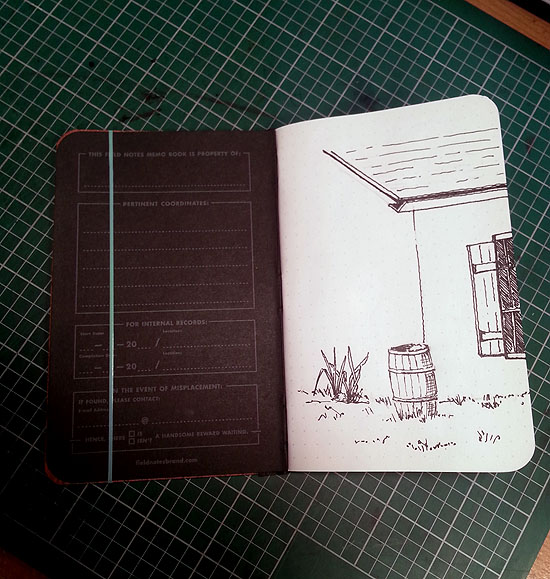
2015-03-20Old Eaves

This sketch was done with a Platinum Carbon fountain pen without much bleed-through so very fine fountain pens work.


This last part is a glitch for a fountain pen guy like myself but for this purpose I don’t even mind switching to a nylon or ball-point pen.  In many ways this is preferable as I can just shove a single pen into my coat pocket along with the notepad and don’t have to dedicate a fountain pen to the process.  I’ve been using a Sharpie, refillable pen (not the markers).  But that floppy problem…what to do.

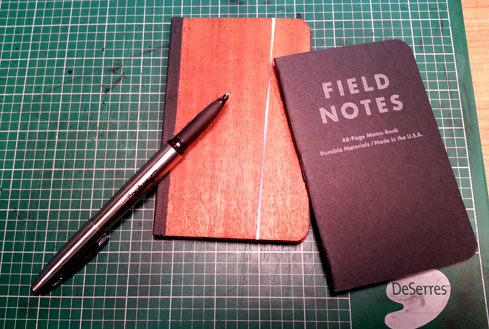
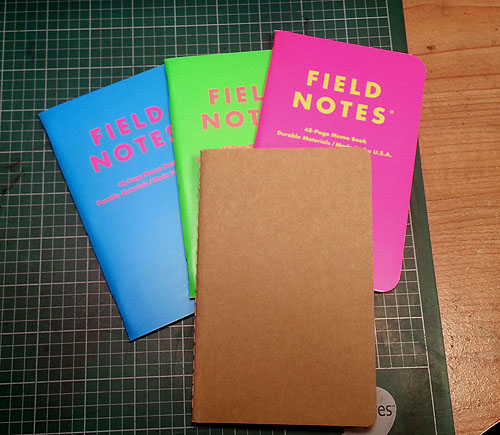
THree Field Notes notebooks and a Moleskine Cahier.  Either works well if you avoid fountain pens.

Three Field Notes notebooks and a Moleskine Cahier. Either works well if you avoid fountain pens.

It required considerable communication between my three neurons but once a plan was formulated it took only a few minutes to create it.  My binder is nothing more than two sheets of 1/16″ mahogany (any thick cardboard would suffice) cut to the size of a Field Notes notebook.  I then laid them, butted against one another, and taped them together with gaffer’s tape.

I closed the binder around a notepad and while holding it firmly together, I put gaffer’s tape on the outside of the hinge area.  Now, when it opens, it forms a stiff platform that’s 6×5.  Works like a champ.  I hold the book in place with very thin hair elastics that I picked up at the dollar store.  Rubber bands work but they generate a bump under the paper.

These books will lay flat, so drawing across the fold is feasible.  I’ve just started using this so only time will tell whether it’s viable but it seems workable to me.  If so, it’s a cheap, very lightweight way to have a sketchbook with you at all times.  If you wanted better paper, of course, you could always make your own for a binder like this one.  I may do it myself as I investigate this further.

2015-03-21fromBrulerie

I did this sketch while looking out the window of a coffee shop. Will it ever warm up?