Sketchers Are Never Bored…Mostly

I’ve made the comment several times, here and elsewhere, that sketchers are never bored.  When I’m sitting in a doctor’s office there are people to sketch.  When I’m waiting for the car to be serviced there’s all sorts of stuff to sketch.  I drew a billboard the other night while waiting to pick up my daughter.  And when there’s nothing on TV I can always sketch scenes in the commercials.  I’ve been known to draw pages full of lines, ellipses, and circles, too.

But I’ve been bored…REALLY bored.  The flu has a way of eliminating all notion of sketching, thinking, looking, seeing, and about the best I could do over the past few days has been to sit and become over-dosed on Olympics coverage.

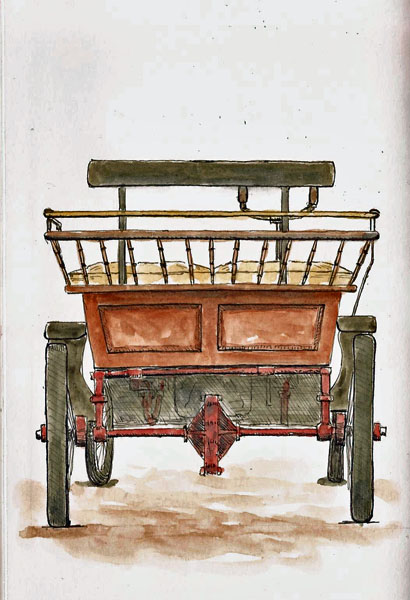
Today the residual ‘tuckered out’ feeling was all that remained of my bout with a gaggle of viruses and I wasn’t going to let that stop me.  I headed to the museum to meet up with Yvan for a sketching session.  I’m afraid I’m still a bit less than optimal but I managed this sketch.  There is an 1898 Renault Mini-Car on display and while I have to get around to the front of it for a sketch, I just love this view from the rear as it shows off its red running gear.

Stillman & Birn Zeta (6x9), Pilot Prera, Lexington Gray

Stillman & Birn Zeta (6×9), Pilot Prera, Lexington Gray

The Sketches That Don’t Get Posted

I’ve never done a count but I think that I post less than 50% of the sketches that I do.  I know this is true if I include my constant doodling.  Sketching is about learning to see, hand-eye coordination and building a vocabulary to turn 3D images into 2D sketches.  While stated often by experts, I think most want to believe that there’s some way to get past the need to practice, practice, practice.

Because of this constant sketching I generally have sketches to post but, right now, I’m sick.  Mr. Flu came to visit our house and I’ve spent the last few days staring at Olympics and debating whether living or dying was the best course of action.  Such is the nature of Mr. Flu.  Because of this, I haven’t done much sketching.

But this morning I read a great post by Tina Koyama.  She came across a couple of her sketches that she’d forgotten about and decided to share.  They were great and appreciated that she took the time to post them.

Her post made me think of all the sketches that never see the light of day and gave me an idea.   In defiance of Mr. Flu, I offer this little doodle I did while looking out the window at three people who were walking slowly down the sidewalk in front of our house.  No big deal and the middle guy’s head seems too large to me, but heck, it’s not bad given that I had a 102F temperature at the time.

Canson Ingres paper, Hero 578 pen

Canson Ingres paper, Hero 578 pen

The Power of the Hero “bent-nib” Pen

Some sketchers love watercolors.  Others are passionate about line.  And, of course, there are those who do a combination of the two, with varying emphasis on one or the other.

For myself, if I had to do one or the other, line work, particularly that made by fountain pen, would be my choice.  My use of watercolor is similar to what I did with crayons when I was a kid – I “color” inside the lines.

My lines tend to be thin and my favorite pens are those that produce them.  Pens like the Pilot 78G, Pilot Prera, and Platinum Carbon pen are among my favorites.  My TWSBI Mini produces a slightly heavier line but even it is finer than the typical “medium nib” pen.

One intriguing exception in my personal fountain pen mountain (and I swear that I need them all) are my Hero “calligraphy” pens.  Some call them “bent nib” pens.  The “calligraphy” moniker is misleading for western-worlders as they don’t work at all like western calligraphy pens but are, rather, designed for writing Chinese characters.  You affect line width by varying the pen angle rather than pen direction as with a western calligraphy pen.

There are several companies that produce them but Hero is the company that seems to make the largest number of models.  They are available in North America for not much money via eBay but one must be careful to ensure you’re getting a calligraphy pen as Hero makes standard fountain pens as well.
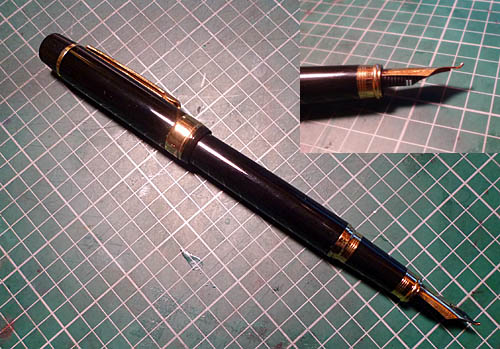
Hero 578 fountain pen.  Note bent tip.

Hero 578 fountain pen. Note bent tip.

I have several of them and I’ve played with them some but have never taken them seriously.  I’ve decided to change that and really learn to use them.  To me, their big advantage is the ability to generate very wide lines as well as fine ones, permitting the creation of larger dark areas in a pen sketch.  Their downside is that I can’t get as fine a line as I can from some of the other pens I’ve mentioned.

I was out the other day and I did this quick sketch from the 2nd floor dining area of our downtown McDonalds.  You can see how even an inexperienced person like myself can generate high contrast sketches using the pen.  Here I’m using a Hero 578, which is a fairly heavy pen but I like how it feels in my hand.
Stillman & BIrn Alpha (4x6), Hero 578, Platinum Carbon Black

Stillman & BIrn Alpha (4×6), Hero 578, Platinum Carbon Black

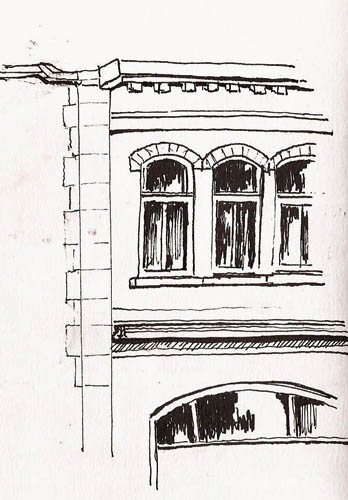
Later, while at the Musée d’Amerique Français I sat in a comfy chair, looked out the window and sketched this portion of one of the seminary buildings.

The folks who have the most experience with these pens are the Singapore urban sketchers.  Maybe with some practice I can begin to emulate them.

Stillman & Birn Alpha (4x6), Hero 578, Platinum Carbon Black

Stillman & Birn Alpha (4×6), Hero 578, Platinum Carbon Black

 

The Missing Sketching Equipment

Most books on sketching will start by telling you how much fun sketching is and how little equipment is required to do it.  A pencil and a piece of paper is sufficient, they say.  And it’s true…sort of.  But it’s a lot more fun if you buy one of each kind of pencil, pen and paint and try every flat drawing surface on the market today…or so it seems if I look around my office.

If you’re a street sketcher, however, there are other things you need.  The most basic thing, of course, is something in which to carry your one of everything, or some subset thereof.  AND, if you’re like me and aren’t comfortable sketching while standing, you need a stool.

StoolOpen_smI carry a Walk Stool myself.  I’ve owned it for a couple years and use it several times a week.  In spite of this heavy use it still looks like new.  It’s light; it’s comfortable; and it folds up small.  But it only works if you take it with you and that was my problem last Tuesday when I went to the Musée de la Civilisation to sketch.  I’d forgotten to put it in my bag.

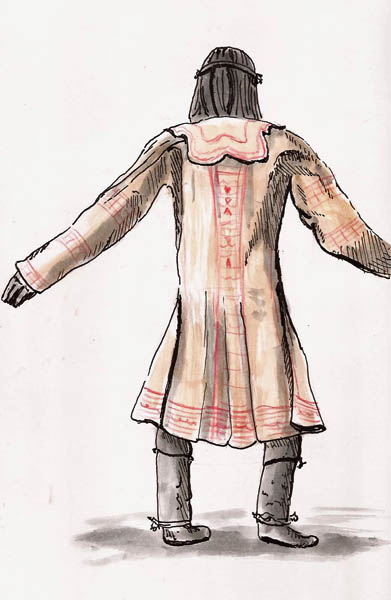
There were lots of things to sketch.  There were lots of places to sit.  The problem was that they weren’t in the same place.  I wandered, and wandered, looking for a place that would provide both subject and seat.  About the third circuit of the museum I my criterion for a suitable place reached a sufficiently low point that I realized that I could sit in the hallway and look through windows at the back of some of the exhibits in the Native American exhibition.  The back of this dancer is the result.

Stillman & Birn Zeta (6x9), TWSBI Mini, Platinum Carbon Black

Stillman & Birn Zeta (6×9), TWSBI Mini, Platinum Carbon Black

Sketching The Art of Fernand Pelez

I rarely sketch from art unless I’m trying to learn how DaVinci did it, or how my buddy Yvan Breton does his people sketches.  But the Paris exhibit at our Musée de la Civilisation has a couple of large that just say “sketch me.”  I think it’s because of their size and content.  One is a 21-foot long mural of the Parisian open-air market in 1900.  The other is an equally large circus mural titled Grimaces et misére by Fernand Pelez (1888).

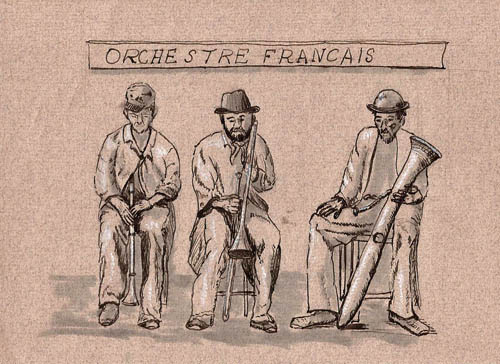
Grimaces et misére depicts circus performers, including dancers, musicians, clowns and others, but unlike most circus art, these figures are depicted in what was probably a more realistic state.  The faces and body language of these characters are sad, tired, and suggestive of their overworked, day-by-day lives.

I, along with my buddy Yvan decided to meet Tuesday morning to sketch the musicians who represent about 25% of the mural.  He drew in pencil; I used my Wahl-Eversharp pen and Noodler’s Lexington Gray.

The paper was Canson Ingres (6×9).  I like the lightly toned versions of this paper for pen drawings, though it would be quite useless for watercolor.  The bit of added tone came from dilute Lex Gray in a waterbrush, while the white was done with a Stabilo “paper-glass-plastic-metal” pencil.  I think Prismacolor pencil does a better job but it was worth a try (grin)

2014-01-28OrchestreFrancais_72For those asking “What the heck is that instrument on the right,” I was equally curious and so I did some digging.  Turns out it is an ophicleide, a precursor to the tuba.  It’s actually a U-shaped tube but the downward part of the tube is behind the upward portion so you don’t see it in the painting.  But you can see the mouthpiece which is very tuba-like.