I’ve posted a couple examples of sketches I’ve done on Strathmore’s Series 400 gray drawing paper and it’s spawned a couple of questions about the sketchbook in particular but also the paper itself. I’m really new to the paper and I’m not a paper guru, but I thought it might be useful for me to discuss my limited experience with these products.
 Strathmore’s Series 400 Drawing sketchbooks have been around for a very long time and most commonly found in various sizes of spiral-bound books with “Drawing” on the cover. According to Strathmore they are and “ideal surface for any dry media, suitable for pen and ink.” I’m not a pastel guy but I don’t think this paper would be useful for that medium but for pencil and pen and ink, it’s an excellent, inexpensive paper. It may lack a bit in ‘tooth’ for those wanting to do detailed pencil sketches.
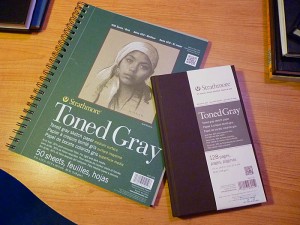 The recent release of this type of paper in both gray and brown is an important event in the sketching world, I think, and even more so because Strathmore has wisely produced brown-covered sketchbooks containing these papers. I nearly went off the rails the first time I saw one of these beautiful sketchbooks. I get bored by the typical black covers and the matt-brown finish of these sketchbook covers speaks to me.
The binding looks good but I don’t have enough experience with it to speak further about it. I should also add that I have no experience with the brown paper version so my comments are limited to the gray paper.

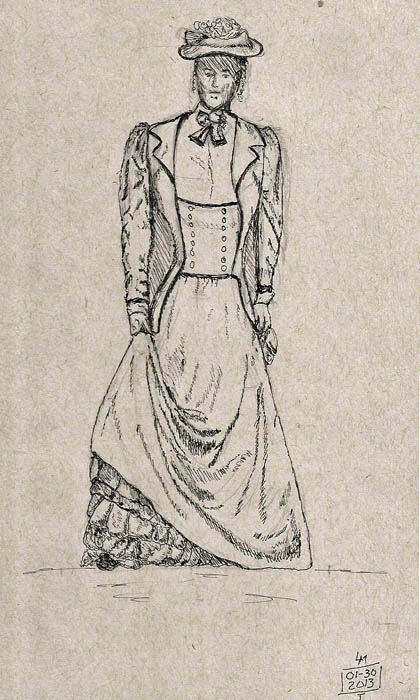
Done with Pilot Prera and Prismacolor white pencil
But I’m getting ahead of myself as I first discovered this paper in a spiral-bound 9×12 sketchbook. These come with finely perforated pages so you can remove the papers cleanly. I did exactly that and use this paper as individual sheets. I found it very nice for pencil sketching, though I admit to know almost nothing about pencil sketching. What I can tell you is that my buddy Yvan is a long-time and certainly excellent pencil driver and he said that “it’s great for ‘sketching’ (in quotes because his sketches are framing quality) but for portrait work the paper lacks tooth.” Those of you who understand this can do your own interpretation. Me, I’m still trying to figure out how to do basic shading with pencils. I’m a pen and ink guy and so I provide the ink sketch on the left, done with Noodler’s Lexington Gray ink.

Series 400, done with Pilot Prera, Noodler’s Lexington Gray ink
My understanding is that the hardbound sketchbooks are available in 5.5×8.5″ and 8.5×11.5″ sizes. As I was in the market for a pen-only sketchbook that I could dedicate to learning how to draw people, I bought the smaller size. I admit that I much prefer drawing buildings, cars and even fire hydrants rather than sketch people but it’s winter and there are more people indoors than there are buildings, so what’s a sketcher to do?
My new Strathmore sketchbook has become my “people” sketchbook. Its 128 pages of gray, 80lb paper works well with the pens I use regularly (i.e. fine nib fountain pens). I did find that if I use a medium nib and lay down a significant amount of ink there is slight feathering with my typical sketching ink (Noodler’s Lexington Gray) but it wasn’t objectionable.
Series 400, done with Pilot G-TEC-C3 hybrid ink pen
As I haven’t done much with the sketchbook yet I don’t have much to show in the way of examples so I’ll include the only two pages of my book that have ink on them. The first is a set of scribbles I did of people parts. There was no intention of anyone but me seeing this and no rhyme or reason to it so I apologize for its scattered nature. The second sketch is my first attempt at sketching clothing folds with pen and ink. Need to work on my darks a lot and proportions even more, but again, here it is. This is a post about the paper, not this sketcher’s limited abilities (grin). In any event, I hope this answers some of the questions about this paper and the new sketchbooks.
Oh…I should add, this paper contains too little sizing and is too light for use as a watercolor surface in my opinion. I have done some experiments and I can get away with adding some shading using a Derwent Graphitone pencil and color with Faber-Castell watercolor pencils, moving both around with a small Sakura Koi waterbrush. Trying to add a graded wash down the side of a building wall, however, is 1) very difficult as the paper is so absorptive and 2) the paper starts to pucker. For myself, I’ll stick to my Stillman & Birn sketchbooks for all my color work. They’re simply the best there is, though I wish I could buy them with brown covers.

 We decided we should take advantage of the Samurai exhibit as it’s going to be leaving in two weeks. I love sketching the many amazing helmets in this display and so that’s what I did. Here are two more.
 This one did take me about an hour but this helmet deserved the time. Representing two bamboo/metal pipes, one on each side, the metalwork here is really outstanding. Much about these helmets is demonstrate status but it was also about identity, as on a Samurai battlefield there were no cell phones; only “There he is. See his helmet?” recognition of your fellow soldiers.