
Sketching In A Baron Fig Apprentice Notebook

One of the highlights of this otherwise miserable winter was taking Marc Taro Holme’s People in Motion class.  During the class Marc suggests that you get a small, cheap notebook and sketch in it constantly.  He recommends the Moleskine Cahier (same paper as the Moleskine notebooks but without the hard cover).

I think the idea of a small, cheap notebook that facilitates sketching everywhere and all the time is a great one.  On recommendation from my mentor and buddy, Yvan Breton, I’ve been doing this for a couple years and it’s done more for my ability to draw than anything else I do.

What I hadn’t tried was the Moleskine Cahier so I bought some.  They come in a 3-pack for about $12 around here.  I was very disappointed because of bleed-through and lots of ghosting when I used my fountain pens.  I complained about this here, and included a bunch of sketches to illustrate the problems.

But what I really did like about these little books was how small they were.  My typical small book has a hard cover and 96 cheap-paper pages.  These books are 5.5 x 3.5 x 0.5″ while the Cahiers are only 48 pages with a thick paper cover and are thus about 1/8″ thick.  Very portable, very light in the hand.  If only….

There are alternatives and I’ve been trying them.  Tina Koyama motivated me to try Baron Fig‘s notebooks, and I think I might be falling in love with their little Apprentice notebooks.

While the typical small notebook is 3.5″ x 5.5″, the Baron Fig is 3.5″ x 5″.  When I received them this threw me off a bit as I was more used to the other size but now that I’ve used it a bit I find that I actually prefer it.  It fits my hand better and certainly fits in a pocket more easily.  Size does matter.

Baron Fig

The books are 48-pages of white (an improvement over Moleskine) paper and cardstock cover.  They are stitch-bound rather than stapled like most of their competition.  It’s a nice touch and the stitching is perfect.

While they can be had with lines, grid or blank paper, I bought a pack of their standard gray notebooks (3 per pack) and a pack of their “limited edition” Time Travel series.  They cost only $10 per pack so, $3.33 per notebook.  Not bad even if you do use a lot of them.

All this is great but the proof is in how they handle ink.  For me that means fountain pen ink.  Typically I use fine nib pens in my small notebooks because of the small format and a side benefit is that it places lower demands on the paper when it comes to bleed-through and ghosting.

But what happens if you do use a lot of ink on Baron Fig paper?  The results are better than I thought.  I decided to try Tina Koyama’s favorite pen, the Sailor Fude pen.  This pen can lay down a lot of ink or a little ink depending on the nib angle.  Here’s the result of this experiment.

2015-02-18library1

Baron Fig Apprentice, Sailor Fude pen, De Atramentis Document Black

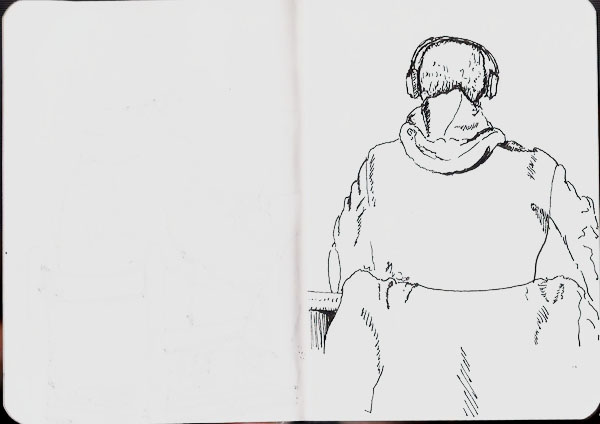
Of course the “proof in the puddin” is to look at the back of this sketch.  Here it is (on the left):

2015-02-18library2

As you can see, there is some ghosting but not much in the way of bleed-through.  We’re not talking about doing drawings that you’re going to frame so, to me, this is acceptable.  The sketch on the right was done with a Namiki Falcon SEF.  This is my typical nib size for these and the ghosting on the back of this sketch is negligible.

But what if you wanted to use the Sailor pen and also wanted to draw on that ghosted page?  Could you do it?  Sure, the ghosting wouldn’t distract from your sketching.  It might, however, not look as nice as you’d like when you scanned it to send it to your favorite social media group.  But, with the magic of Photoshop (or some other graphics program), you can easily remove this ghosting so that it looks like this:
2015-02-18library2.1

These results are the same as I’ve gotten from the paper in my cheap hardcover books so I’m thrilled and the paper in the Baron Fig as it looks better and feels better.

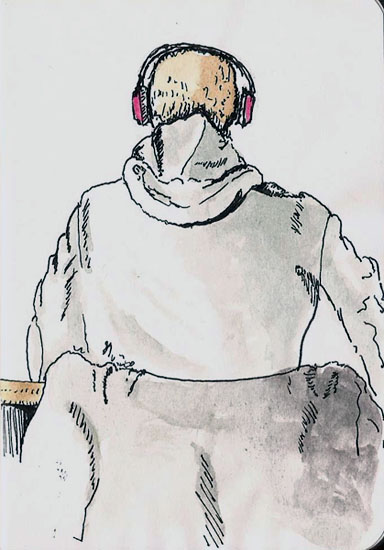
My cheap book sketches rarely see any color, simply because I’m generating lots of sketches as I wander through my day and so there’s no time for color.  But, for this post I decided to add a bit of color to see how that worked.  I kept the washes light and didn’t expect to move them around much.  I was surprised at how well it worked.
2015-02-18library3

Baron Fig Apprentice, Namiki Falcon, De Atramentis Document Black

This is definitely not watercolor paper but I was happy with the results.  This does increase the ghosting a little bit but surprisingly little, as long as you wait for the paper to dry.  This definitely opens the door for me to use my gray and brown waterbrushes to shade drawings on the fly.  If you’re looking for a small, very portable, sketchbook solution, the Baron Fig Apprentice might be what you need.
 

Sometimes Sketching Isn’t About The Sketching

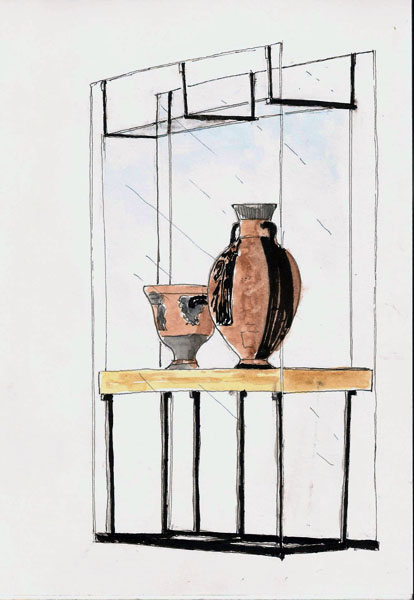
My daughter is home from school for a week and I got a late start as I headed to the museum to do some sketching.  By the time I got there it was nearly 11AM and I found that three of my friends had been there since opening time.  Two of them I hadn’t seen in quite a while so we spent some time ‘catching up.’  Ultimately we decided to meet in the cafeteria for some of their divine cremed turnip soup.  And so it was when I headed off to find something to draw.

Then I realized that soup time was only 25 minutes away.  Hmmm…  Rather than starting a long pencil drawing of one of the statues I decided to whip out the Namiki Falcon and use it to do a simple sketch of one of the glass cabinets and their contents.  These things are two huge sheets of glass set parallel to one another with a table inside.  The area above the table is encased in a big glass box.  Easy peasy, says I.  By the end my eyes had crossed trying to follow transparent sheets of glass inside of sheets of glass.  It was fun though.  The soup and company were better.  Sometimes sketching isn’t about the sketching.

Stillman & BIrn Alpha (10x7), Namiki Falcon, De Atramentis Document Black, Pentel brush  pen with Platinum Carbon ink

Stillman & BIrn Alpha (10×7), Namiki Falcon, De Atramentis Document Black, Pentel brush pen with Platinum Carbon ink

Hibernation’s Hidden Costs

It’s currently -13F outside.  This, they say, is a ‘warming trend’ and in reality it is warmer than it was just a few days ago.  But from the perspective of a street sketcher, it matters little whether it’s -13 or -30 outside, I stay inside.

Mid-winter depression is a real phenomenon in places like Quebec, where I live, but for me, it’s more like cabin fever.  I spend too much time looking out the windows, wishing for a place to sketch.  In previous years our Museum of Civilisation has been that place and the displays there have kept me busy throughout our long winters.

But this year, half of the museum is closed due to a fire that occurred just as winter was starting and what’s left are displays of early animation where you can watch endless series of cartoons and the Olympus exhibit which is filled with lots and lots and lots of plaster statues of Zeus, Aphrodite and their kin.
Sketching them was fun at the outset but I truly am a street sketcher that likes drawing buildings.  Yet another plaster head is just not cutting it anymore and so my sketching is floundering somewhat these days.  I doodle a lot but it’s just not the same.  So, I decided to draw a window.  It was just one lowly window, drawn in a 3×5 sketchbook, but it sure felt good (grin).

2015-02-06window

Moleskine watercolor notebook, Namiki Falcon, De Atramentis Document Black ink


My Sketching Brakes Are Ineffective

Recently I’ve been on a quick-sketching binge.  Everything I look at got scribbled onto paper in a minute or two.  That’s a lot of fun and, I feel, it helps me “see” shapes and their relationships more quickly.  But it’s sort of like eating a steady diet of Twinkies.  You might even like Twinkies but at some point you’re going to want an apple.  I needed an apple.

I stopped to pick up a pound of coffee at a local coffee roastery.  I decided to sit and draw so I also bought a coffee as an excuse to inhabit one of their chairs.  I sat on a high chair near a window and two guys sat down near me, below my eye level, and I saw an opportunity to ‘know’ that my subject would be there for a while.  I started sketching with the idea that I would have ample opportunity to truly capture their essence.

Have you ever gotten off the freeway and had a hard time driving as slowly at the side street speed limits require?  That’s how I felt.  I started blocking out the sketch with some well-placed dots and then found myself scribbling details.  I tried to slow down but my quick-sketching brain just wouldn’t let go.  This was a constant struggle throughout the process.  The result was a sketch that wasn’t quite a quick-sketch but not what I was really trying to accomplish.  I think I have to get my sketching brakes checked.  Oh…and how do you draw shaved heads?

Stillman & Birn Alpha (10x7), Pilot Falcon, DeAtramentis Document Black, Pentel brush pen

Stillman & Birn Alpha (10×7), Pilot Falcon, DeAtramentis Document Black, Pentel brush pen

Whirlwind Quick-Sketching Tour

Remember me?  I’m the guy who used to post on this blog.  Seems like it’s been a long time since I have, but I have an excuse – kinda.  I’ve been sketching up a storm and I’ve had nothing to report.

I know that makes no sense but I don’t make sense on a regular basis so what’s new?  Here’s the deal.  I’ve been taking art classes.  First I took Liz Steel’s Foundations class.  This is a wonderful class taught, as twelve well-organized lessons.  I thoroughly enjoyed it and in spite of having been exposed to the ideas because of my voracious reading propensity, I learned a lot and did a LOT of sketching for this course.  If I had any idea whether Liz is going to teach this course again I’d tell you where to sign up.  I don’t so you’ll have to ask her.

Then I signed up for Marc Taro Holmes’s People in Motion class, which is offered by Craftsy for a pittance.  Marc is not only a superb artist but an amazing instructor.  I’ve burned through a lot of paper following Marc’s attempt to teach me to draw people in a “painterly” fashion.  Still much work to be done on that front I’m afraid.

So why don’t I have a lot of sketches to post from those courses?  Because when I took my first online course I came to the conclusion that, for me, posting results of my efforts in a class really stifled my openness to the new ideas and approaches.  I would become concerned about complete, postable sketches rather than doing the real work of struggling to do whatever was being taught in the course, relying more on what I knew than what I was trying to learn.  And so a “policy” was born and you’ll never, well almost never, see anything I do in association with a course.  I believe I’ve made an exception twice.

What do I gain from this goofy way of viewing courses?  Freedom.  Freedom to spend time copying the instructor’s work, trying to get into their heads.  Trying to feel their way of visual thinking.  Getting as far away from my own way of doing things as possible.  Not worrying about “complete” anything if it serves the purposes of learning.  I’ve spent pages just making marks with a Pentel brush pen in an attempt (failed thus far) to achieve the marks that Marc makes consistently.  I’ve done dozens of thumbnail sketches of my office and its contents in an attempt to understand how Liz dissects an area she’s looking at and I’ve copied her pages of thumbnails to see if I could get a sense of her visual thinking as she looked at the scene she showed us in the video.

But if you’ve read this far, let me abuse you some more (grin).  One of the things Marc emphasizes is drawing regularly and he suggests the Moleskine Cahier as a “scribbler” notebook so you can do quick sketches everywhere you go.  I’ve followed this practice for almost two years and in my view, this is the way to learn to draw quickly and no amount of drawing from photos teaches what a ‘scribbler’ will.

2015-01-29guy1I’ve never thought much of Moleskines but decided to give the Cahier a try in a whirlwind quick-sketching binge.  I filled one of these notebooks in three days.  I admit that I had to skip the backs of some pages as it was impossible to draw on them because of severe ghosting and bleed-through but more on that later.  I approached this with the idea of trying different techniques and pointy devices so I’ll show you’ll see that reflected in the sketches.

2015-01-29guy2

Here are a couple sketches done in my typical style.  I suppose they do reflect Marc’s course a bit as I tried using a Pentel brush pen to add emphasis to some of the lines but mostly they reflect my limited style of doing 1-2 minute sketches of people on location.

2015-02-01_1I’ve included this one to show you the problem I ran into with ghosting and bleed-through.  This one is only moderately bad.  Many back pages were so bad that the it was impossible to even think about drawing over it.

2015-02-01_2decided to do a very dark sketch.  This guy was actually holding a cell phone but somehow he ended up with a book in his hand.  Not sure what my brain was doing to cause that to happen.

2015-02-01_3This guy caught my eye.  His thin face and odd hair reminded me of someone in a movie but I can’t tell you who.  In addition to making his eyes too big, I decided to add watercolor and learned that the Moleskine paper generates little spots in any wash you lay down.  What’s up with that?

2015-02-01_4

Here’s another one that shows some of the ghosting in this notebook.  Very distracting while drawing but this was ‘practice’ so it shouldn’t matter, right?  It mattered…to me.

The next day I went to a coffee shop and started a repeat performance.  I had learned that I really needed to work on the brush pen as I have no control over it whatever.

2015-02-01_5This first sketch (actually the third as the first two were destroyed by bleed-through), suggests that I was a bit timid as I didn’t do much with the brush pen.  Frankly, I think it’s one of the best so maybe that is an indication that I need to use brush pen less.  I kept the watercolor very light as I was trying to conserve the backs of the pages.  Didn’t help much.

2015-02-01_6For this guy, I got carried away with the brush pen in an attempt to learn how to control it.  There was also a certain amount of “if the little mark looks horrible, making it bigger will somehow make it better” going on here.

As I finished up my café allongé the guy below set up his laptop and sat down to look out the window and scroll through his Twitter feed.  I was getting tired and so decided this would be my last sketch of the day and I ended up spending a couple extra minutes faking in some of the ‘across the street’ features of the scene.

2015-02-01_7.0

The next day, 30 or so sketches into this marathon, I went to a food court.  I decided to use a ballpoint (Parker Jotter) for these sketches.  This does solve the ghosting and bleed-through as long as you avoid watercolors.  But what fun is that?  Anyways, I drew a bunch of people ordering food until I ran out of pages.

2015-02-01_8 2015-02-01_9


So, what did I learn?  Well, you can draw nearly 40 quick-sketches in three sessions if you want to and limit each to a couple minutes each.  I learned that I REALLY don’t like Moleskine Cahiers.  The notebooks I’ve been using cost me $1-2 from the dollar store, have twice the pages and half the ghosting/bleedthrough problems.

But I do really like the ‘cahier’ notebook format.  Field Notes and Baron Fig’s Apprentice series all come in blank paper format or even dot-grid which I find acceptable.  The very thin nature of these notebooks works against them in terms of paper thickness, though.  They typically have 12-sheet signatures which is too many if want 140lb watercolor paper.  But there’s a middle ground and improved paper quality, even if it’s only a 60lb paper, would go a long way towards mitigating the problems.  I’m looking for such a solution so if you know of any 30-40 page, thin notebook that tolerates fountain pens without the back of its pages being obliterated, let me know.