How Do You Use A Pencil?

Long before I decided to learn to draw I was a fountain pen guy.  I’ve always loved the feel of a nib running across paper.  So when I started trying to learn to draw, I used a fountain pen.  It’s still my tool of choice some two years later.

Some would argue this is a good thing as it forced me to look a lot and draw a little as erasers weren’t part of the process.  I think this is true and that it has helped me acquire a rudimentary ‘artist’s eye’, though that eye is still ill-developed.

But at the same time, I missed out on the more typical starting point for someone learning to draw – graphite or charcoal.  The pencil remains a very popular drawing tool and I’m completely ignorant of its uses.  I do carry a mechanical pencil but it’s full of 3H or 4H lead and I use it just to draw a few guidelines to block in a drawing and I quickly switch to pen for the rest.  So I’ve decided that I need to learn a bit about 2B, HB, and 4H pencils and how to rub them around to create value.  I also need to learn what you do with a kneaded eraser.  It’s a very clumsy process.  But I’m trying, mostly with little scribbles and doodles.

Monday I went with Yvan to the nearly hidden ‘museum’ at the university.  It holds the contents of the long defunct natural history museum, the university insect collection, and roughly 300 plaster casts.  These were given to the university sometime in the 19th Century, when art departments thought it wise for their students to learn to draw.  When they decided that you didn’t need to draw to be an artist if you were going to paint with a roller, spatula or by throwing paint at the canvas, all the casts were, well, cast off.  Only the insight and diligence of Madame Wagner, the curator of the ‘museum’, saved them from becoming so much broken plaster.

And so little old me has access to some 300 plaster casts of hands, feet, ears, noses, busts of famous people, and many, many full-size statues.  It makes even this street sketcher say KEWL!  I chose a poet named Benivieni as my first subject.  It wasn’t due to any affinity for him as I have no idea who he is but I liked his hat (grin).

Here’s my first attempt at doing a bust with a pencil.  It’s not perfect but it does, sorta-kinda, look like him so I was both surprised and happy.  I do have to work more on that ‘artist’s eye’ as seeing the half-tones is a challenge, but I think I’ll go back next week.  Those art students don’t know what they’re missing.
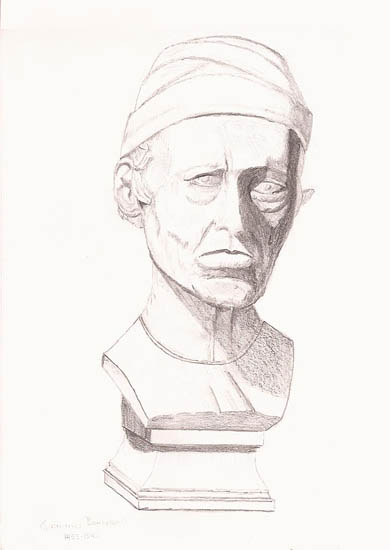
Stillman & Birn Alpha (9x12) with pencil.

Stillman & Birn Alpha (9×12) with pencil.

Biding My Time Til Spring

Tomorrow is April Fool’s Day but Quebec City is still waiting for spring.  It is the case that Mother Nature gave us clear skies today but, like my attitude toward politicians, I’ve taken a ‘fool me once…’ point of view of Ma-dam Nature.

And so as I wait for her to stop playing with my sensibilities, I’ve look for places and things to draw.  I’m not much of a people sketcher as they just don’t interest me very much but what’cha gonna do when the snow is falling and the temps are below freezing.  I quick-sketch people.  It’s fun but the results somewhat embarrassing (grin).

2014-03-27PianistHere’s a couple sketches from a recital I attended recently.  They were done in a Strathmore ‘toned gray’ sketchbook with a Pilot Prera.  If there’s shading it was done with waterbrushes with a few drops of ink added to them.

The larger one was an attempt to capture audience and musician but time ran out and the cellist walked away before I was done so he and the cello remain unfinished.  Such is life of a real-time sketcher.

2014-03-27Cellist

2014-03-27Trombonist's legsI include this tiny sketch because I thought it funny.  Not sure what I was thinking.  Well, actually I do.  These legs were attached to a trombone player and between her being short, the woman sitting in front of me being tall and her music stand, these legs were my only connection to the “action”, seen between two member of the audience.

A couple days later we were invited to a read-thru rehearsal for a play by the Quebec Art Company.  Yvan does the marketing posters for them.  I found this a near-impossible challenge as the actors were moving around on stage almost constantly and my people art ‘vocabulary’ is insufficient to draw people who are changing their positions every few seconds.  I took advantage of one guy who was supposed to be dead (spoiler alert – he wasn’t) and drew him but, as you can see, I resorted to drawing some of the props.  I did a fantastic chair but I won’t bore you with chair and sofa drawings (grin).   These were done in a Stillman & Birn Alpha (10×7) using Pilot Prera and Lexington Gray.

2014-03-30LendMeATenorAll in all, it’s all good.  The more I move pointy devices across paper, the better I get at it.  Working at different speeds is like cross-training and all speeds seem to benefit.  Still, I’m hoping spring comes “real soon.”

Mo Music, S’il Vous Plait!

We’re back in the deep freeze here in Quebec.  Will it never end?  But we’re also in the middle of recital season, a time when the students at Conservatoire de Musique give recitals and what a joy they are to attend.  Today it was pianists…amazing pianists.  Marie Robitaille, Sophie Doyon, Brigitte Legendre, Bruce Gaulin-Boilard, Manuella Gagnon, Corolane Tremblay, and Ariane Filion-Thériault each graced us with their musical prowess.

Stillman & Birn Alpha (4x6); Pilot Prera, Noodler's Lexington Gray ink

Stillman & Birn Alpha (4×6); Pilot Prera, Noodler’s Lexington Gray ink

And while they did, Yvan and I sketched, though I have to admit that at times I just stopped, listened and watched magical hands on keys.  But here are a couple sketches I did during the nearly two hours of music.  Thanks to the Conservatoire, the students, and Suzanne Beaubien-Lowe (their teacher) for making a very cold day seem just a little bit warmer.

Stillman & Birn Alpha (4x6); Pilot Prera, Noodler's Lexington Gray ink

Stillman & Birn Alpha (4×6); Pilot Prera, Noodler’s Lexington Gray ink


First Outdoor Sketch of “Spring???”

I was heading downtown the other day, marching along ice-covered sidewalks and hopping over occasional mounds of snow when it occurred to me – it was pretty “warm.”

Now you’ve got to understand what the word means in early March in Quebec City.  It means I was walking briskly, wearing a sweater over a long-sleeve shirt and with a heavy coat on top of that.  It was “warm.”  The temperature had risen all the way to -5C (22F).

And possibly a result of my being a street sketcher harboring a desperation brought on by a long winter, I made a decision.  Rather than go to the coffee shop, or to the library, as I was planning, I would head to Place D’Youville (a central location inside our old, walled city) and sketch something OUTDOORS!!!

And it all started great.  When I arrived there were a bunch of ice skaters waiting for the Zamboni to clean off the ice rink.  I took a position among them on one of the benchs, got out my Stillman & Birn Alpha (4×6) and my Hero 578.  I wasn’t completely delusional about the definition of “warm” so I decided this would be a sketch done quickly.

By the time I got to thinking about adding some details, the notion of “warm” had long since disappeared, as had my ability to feel the pen in my hands.  My brain had shifted from “get it right” to “get it done” and I was quickly bringing the sketch to a close.  I packed up and headed for the McDonalds on St. Jean Street.

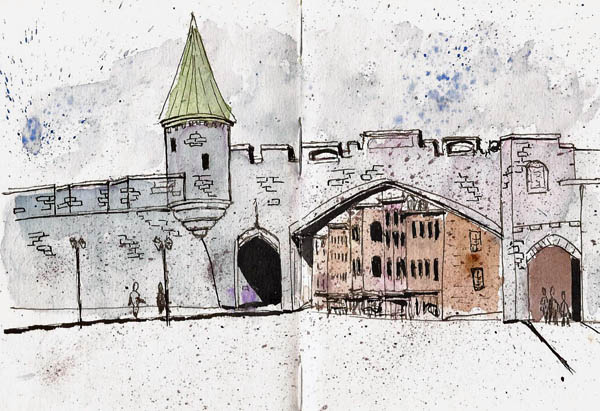
2014-03-07StJeanGate_72After huddling over a cup of coffee for warmth, I decided to add some color and got the bright idea to “boldly go where Larry had not gone before” and play with mixing color on the paper and I capped this off with a bit of splatter.  While I had no idea what I was doing, there was a serendipity about the process that was fun.

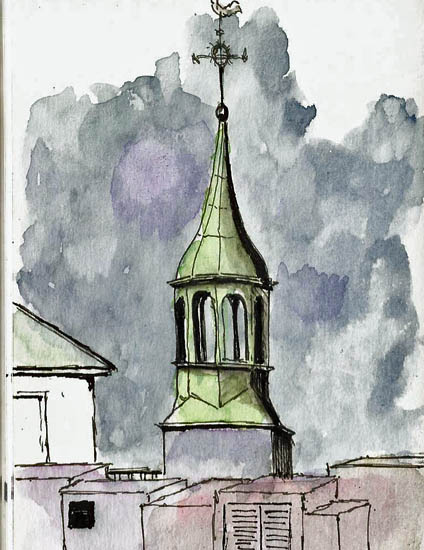
2014-03-07Steeple_72Because McDonalds was very busy, they’d opened up their third-floor eating area so I headed there, hoping to get a different look at the rooftops.  Unfortunately, there were big posters covering most of the windows so the view was limited.  But, by ducking down and shifting forward a bit, I could see under an ad for something called a McWrap and I could see the steeple of a small church next to the downtown hospital (founded in 1639).  It stuck up behind a pile of metal thingies on top of the building in front of it.   Same sketchbook here but I used my Pilot Prera on this one.

While it wasn’t as “warm” as I thought, it was a great day and, as they say, I broke the ice on 2014 outdoor sketching… almost literally.


Shading Quick-Sketches Quickly

Many sketchers enjoy doing quick-sketches as they can be done while waiting in line, sitting in a doctor’s reception room, or in any food court.  You can do them while driving down the highway, though it’s best to have someone else driving.  I fill several sketchbooks a year with these kinds of sketches, each taking 1-3 minutes.

But one thing these simple line drawings lack is any sense of tonal variation – unless you add it.  As a couple people have asked about how I do it I thought I’d talk about my process, though I’m a rank amateur at quick-sketching.  The same technique can be used to color more complete drawings as well.

The most common form of shading quick sketches is to use an ink that isn’t waterproof.  Most fountain pen inks are not so you have a wide range of colors, brands, and pens to choose from.  I believe Goulet Pens say they stock 600 inks, and most of them are water-soluble.

2013-02-13QS2

Done in Strathmore “toned gray” sketchbook, using J.Herbin 1670 ink. Click to enlarge.

If you carry a waterbrush (with clear water), shading with water-soluble ink  is easy.  You simply run the pen along one side of the line, pulling color from the line and into a shape to indicate shading.

While this is, by far, the easiest approach there are a couple of potential drawbacks.  First, drawing ink away from the lines diminishs the lines and possibly makes them fuzzy.  This can be good or bad, of course.  The other limitation is that your shading is the same color as the lines.  Again, sometimes good, sometimes bad.

 Shading brushes

Stillman & Birn Alpha, Noodler's Lex Gray and brown & black waterbrushes

Stillman & Birn Alpha, Noodler’s Lex Gray and brown & black waterbrushes. Click to enlarge.

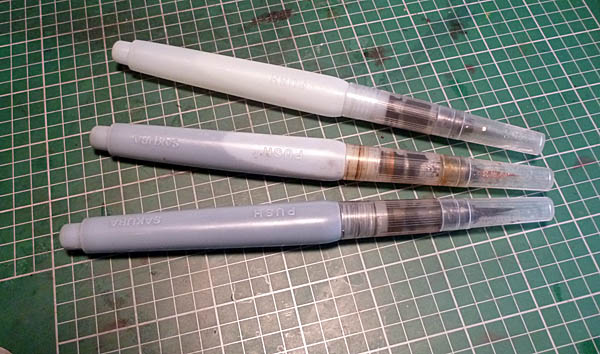
For nearly a year, now, in addition to a clear-water waterbrush I’ve carried a waterbrush where I’ve added a few drops of Noodler’s Lexington Gray and another with a few drops of Noodler’s Polar Brown.  This gives me the flexibility to use both a brown and a gray to shade my drawings and I can do it in seconds.  I keep the shade from the waterbrush very light so that I can apply multiple coats and obtain a range of colors.  I think the very dilute solution helps keep the brushes flowing properly.  I use a waterproof ink (Noodler’s Lexington Gray) for the linework so that it’s unaffected by the shading.

Stillman & Birn Alpha 4x6. Pilot Prera & gray waterbrush. Click to enlarge

Stillman & Birn Alpha 4×6. Pilot Prera & gray waterbrush. Click to enlarge

If you enjoy quick-sketching, give this approach a try.  Easy to carry, easy to apply when there’s no time for a full watercolor treatment.

Some quickies at the coffee shop.  Click to enlarge.

Some quickies at the coffee shop. Click to enlarge.

Using both color sometimes enhances the scene.  Click to enlarge.

Using both color sometimes enhances the scene. Click to enlarge.