Fall Is Here; Just Say No To Snow!

Fall officially came to Quebec a couple weeks ago.  Many of the trees, and certainly Mr Weathermaker, didn’t get the memo.  We’ve had very warm temperatures for a last couple weeks and the trees are very confused as daylength tells them to drop their leaves but the temps are saying “not yet.”

But, slowly and as surely as politicians will screw things up, winter is approaching.  For me, a street sketcher, it’s a time of transition.  It’s a time when I start figuring out what/where I’m going to sketch once it gets too cold outside to do what I love – sketch on the streets.

To that end I’m thinking about museums, have convinced myself that I should try, again, to sketch from photos, and that I should use Google Maps “pegman” to sketch in exotic places while snow blankets my world.  We’ll see.

toned paper; Pilot Prera and Prismacolor white pencil

toned paper; Pilot Prera and Prismacolor white pencil

In the meantime I’ve been doing some sketching.  I received a handmade tan-paper sketchbook from my buddy Pat Ng in Singapore and did this sketch to sort of break it in.  The gulls love to sit on the lamp posts around here so I had plenty of source material for this sketch.

This sketch was done in celebration of the show the trees put on for us every year.  Fairly simple, I combined a Uniball UM-120 black pen (.5) with a Uniball UM-151 brown-black (.38) pen and did it in a Stillman & Birn Alpha (4×6) sketchbook.  The fence lets me call it an ‘urban sketch’ 🙂

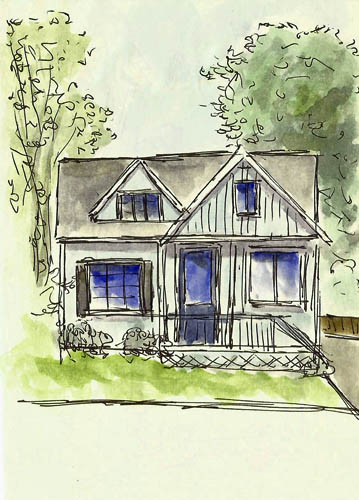
2013-10-07Fall2013-10-07QuickHouseI spent Monday night looking at a bunch of sketches done by Liz Steel, a very talented architect/sketcher.  She talks about how she works very quickly and why.  The next day I was walking down a street and saw this little house.  I decided to try out Liz’s philosophy/approach and while I didn’t produce anything near the quality of her sketches, once I buried the ‘ooooo…that’s not right’ and ‘oops…left that out’ I found the results interesting and I’ll probably do some more like this.  Took less than 10 minutes, including the time to get out my watercolor kit and waterbrush.  It was done in my ‘el cheapo’ 3×5 notebook and my Uniball UM-120 (.5) pen.

Sketching, no matter how it’s done, is fun and after two years of doing it, I can’t imagine a day without it in my life.


Another Trip To Ile D’Orleans – Pt 2

I left you, in part one of this saga, with me very relaxed in a small park, having just sketched a lamp post.  It was a very nice day and only 10AM, so I got in the car and drove to the other end of St. Jean, which is a really small town so it only took a couple minutes.  I returned to the place where I’d sketched this during a previous visit to the island (Ile d’Orleans).

2013-09-18IleDOrleans1This time of year our maple trees put on a show for the tourists and we become overrun by cruise ships that come in from the Atlantic just to see this spectacle, so I decided to do another sketch of this area that featured the blazing colors of our forests.  While this sketch was done from the pier, I moved much closer for the new one, concentrating on just a couple of the homes so that the trees could dominate.  I did this new sketch in my Stillman & Birn Zeta (5×8) using a Pilot Prera filled with Platinum Carbon Black ink.

2013-09-30IleD'OrleansStJean

Click to enlarge

I’m a slow sketcher and something this size takes me a while – a while sitting on a little tripod stool on rocks, in the sun.  You get the picture.  I was pretty tired when I finished so I started driving down the southern coast of the island, looking for a nice place to eat a lunch and just relax.

Along the way I was doing what sketchers do; I was taking ‘inventory’ of potential things and places to sketch along the way.  I’ve got to spend more time on the island as there’s a lot to sketch there.  As I was driving I noticed a sign that said “Parc Maritime” and way down below the road I could see what looked like a couple boats and a parking lot.  It seemed as good a place as any to eat lunch so I turned around, found the entrance, and drove down to Parc Maritime.

A half hour tour later I had learned that the town of St. Laurent revolved around this facility in the early 20th Century and that it had been a major hub for the construction, repair, and storage of the cargo vessels that ran around the St. Lawrence, mostly moving wood products.  It had been an enormous facility employing everyone in St. Laurent and a lot of people who came from surrounding towns during the summers.  This is a great place to visit, an amazing place to sketch.  I was told that I could return to sketch anything I wanted as long as I paid the entry fee (grin).

I was pretty tired and hungry, though, so I wandered the forest, looking at remnants of the lisses, which were row after row of large railroad track-like thingies they used to slide large ships out of the water and then move them laterally along the shore for storage.  This is a really nice place, hidden from view for the most part by the fact that it’s now tree covered and well below the main road.

When I finished lunch it was getting late but I decided I had to sketch something so I chose a small chaloupe, a heavy-duty rowboat.  There is a shop on the premises where they built them and I’ve got to get back to sketch all the cool benches, tools, and a water-powered bandsaw contained within.  But today I limited myself to one of the boats.  This one was done in my small Moleskine watercolor (3×5).  Hope you like it.

2013-09-30IleD'OrleansBoat

It will soon be too cold to visit the island.  These days, on the weekends, there are just too many people as it’s apple-picking time and people who want to do this form kilometer-long lines of cars, all waiting to drive over the bridge and onto the island.  This is not for me but maybe, during the week….   We’ll see.

Another Trip To Ile D’Orleans – Pt 1

I finally got out sketching and it was a fantastic day. Unseasonably warm and not much wind so I headed back to Ile d’Orleans where I sketched and froze the last time I was on the island. This steeple is attached to a church that’s on the eastern end of the island, in the town of St. Jean.  Its bright orange roof must serve as a visible beacon for the cargo ships that come from the Atlantic and are making their way towards Quebec City.

The church is across the street from a place that sells great brioche and coffee.  Last time I was there they’d lost electricity because of high winds so there was no coffee but it’s a regular stop for me when I get out to the island.

Moleskine watercolor (3x5), Pilot G-TEC-C3 pen

Moleskine watercolor (3×5), Pilot G-TEC-C3 pen

Once I sketched the steeple, I walked across the street to get my coffee and danish and this time it was closed because, it seems, it is closed on Mondays. Disappointment didn’t last too long, though.  They have a lot of chairs in a very pleasant garden area so I took one and set it up so that I could sketch one of the unique lamp posts in St. Jean.

2013-09-30IleD'OrleansLamppost

Moleskine watercolor (3×5), Pilot G-TEC-C3 pen

Have you noticed that some sketches are more ‘relaxed’ than others as you do them? That’s certainly the case for me. In this case, I’d just finished staring hard at all the detail in the steeple and mostly just wanted to sit.  Because of the situation, I was sitting on a gorgeous ‘throne’ in the form of a sculpted, cast-iron chair, with grass beneath my feet. The temperature was perfect, the sun was shining, and I was sitting in the shade.  If I’d gotten any more relaxed I would have fallen asleep.  The worst day sketching is a good day but some are better than others.

Location Sketching On Ile d’Orleans

“In 1814 we took a little trip,
along with Colonel Jackson
down the mighty Mississip.
 
We took a little bacon,
and we took a little beans,
and we fought the bloody British
in a town called New Orleans.”

These lyrics, sung long ago by Johnny Horton, tell of the final battle of the War of 1812 where Americans defeated a British invasion force.  The song was a big hit when I was a kid and every time I head to Quebec’s Ile d’Orleans that song rattles around in my brain.  Truth is, the French had their own battle against a British invasion and Wolfe, the leader of that invasion force, nearly died when his ship ran aground just off the coast of the island, and within cannon distance of the French forces.

But war is not the topic of today’s post.  Rather, it is about a trip I took recently to Ile d’Orleans to sketch.  I use ‘trip’ loosely as it takes all of fifteen minutes to get there as you can see Ile d’Orleans from Quebec City and vice versa.  Going to the mall takes longer.

Ile d’Orleans is a big island in the St. Lawrence River, just as it widens from its narrowest point, at Quebec City, on its way to the Atlantic Ocean.  There are six municipalities on the island, though I have a hard time determining where one begins and another ends.  What I know is that the island is gorgeous and I love my time there.  A lot of vegetable and fruit growing goes on, and it’s a very popular tourist location.

I’ve sketched on the island but I’ve never gone there alone, with the singular goal of sketching.  This day, I was on a mission.  The sun was out, I had sketchbooks a plenty, and I’d arranged to have our car for the day.  I arrived on the island about 8:45 and drove to the backside of the island to a pier that juts out into the St. Lawrence.  I discovered it when I was with my buddy Nicolas and we were like a couple kids, chasing the Queen Elizabeth II as she passed along the southern coast of the island on her approach to Quebec City.

2013-09-18IleDOrleans1

Moleskine watercolor (3×5), Pilot Prera, Platinum Carbon Black

I walked out onto the pier, set up my stool and began sketching.  You know what?  Sun doesn’t help much when there’s a 20-30km/h wind blowing across a large body of water and its hyper-cooled air is cutting you in half.  I was COLD!!!  At one point I went back and sat in the car for a while to warm up but, finally I finished the sketch.  I was a bit too much in a hurry, do you blame me, and ended up with some paint blooms in the foliage because my previous wash wasn’t yet dry, but them’s the breaks.

I was really cold when I finished and so headed for a place I knew that serves wonderful brioche and good, hot coffee.  Unfortunately, the winds had blown out their electricity – no coffee.  So, I bought a brioche and sat in the car, with the heater running, to warm up.

2013-09-18IleDOrleans2

Stillman & Birn Zeta (5×8), Pilot Prera, Platinum Carbon Black

Across the street from the café is a church and a cemetery.  I keep telling myself that I should draw more in cemeteries as I love the shapes of the grave stones and their helter-skelter orientations, probably caused by the annual freezing and thawing of the ground.  I found a view I liked, went back to the car to get my stuff and I was soon sitting in the cemetery sketching.  This was a little better as there was a stone wall around the area that broke some of the wind.  I was only semi-frozen when I finished this one.

I was getting ready to leave.  Actually I was turning around in the church parking lot when my eye caught a “Privé” sign and a lamp post.  I love to have such things in my sketches and so I decided to sketch this scene.  Once again, however, I would be fully-exposed to that darn wind coming off the St. Lawrence.  I am old but even I can learn new tricks.  I positioned the car so I could sketch while sitting inside.  About halfway through I was wishing I had a hacksaw to eliminate the steering wheel but it worked out ok once I got the hang of it.

2013-09-18IleDOrleans3_sm

Stillman & Birn Zeta (5×8), Pilot Prera, Platinum Carbon Black

There’s so much to sketch on the island that I could go there every day and not get bored.   In another couple weeks the trees should be putting on their annual ‘fall colors’ light show and I’m going back ‘real soon.’

Sketching On Location – Matthew Brehm

I have few inherent talents.  I can’t throw a ball 100mph.  I can’t devise new laws of physics.  But I’ve got an intense curiosity and my persistence factor is off the charts.  .

I have come to art late in life and my solution to the ‘you’re old; you don’t have much time’ dilemma has been to read everything and anything about drawing, coupled with a whole lot of doing.  Nick Meglin (Drawing From Within) is right when he says that the book that will teach you the most about drawing is your sketchbook.

But there are insights one can glean from books and those ideas and techniques can have small or large effects on how quickly you can progress.  Besides, I’m an ex-scientist and that translates into a view that understanding what smart people think is good for me.

A few things have come from wandering through dozens of ‘drawing books’ written from the 1800s onward.  It’s clear there is a difference between how drawing was once taught and how it’s being taught now.  If one reads 19th Century drawing texts one is taught to draw everything and to do it from observation, probably because most jobs for artists actually required that skill.  Modern texts from the art world all seem to assume that artists draw naked people or draw from their imagination in a studio.  It’s barely acknowledged that anyone goes out and draws planes, trains and automobiles anymore and, if one looks at the art hangs as ‘modern art’ in museums, they don’t.  Deanna Petherbridge suggests, in her Primacy of Drawing, that a renewed interest in representational art is causing a renewed interest in drawing.  I hope she’s correct.

Another thing I’ve noticed is that the sketching world is full of very good sketchers, drawing from observation.  They are masters of their craft; they are my heros.  A surprising number of them are graphics illustrators, comic book and animation artists and ARCHITECTS!  Liz Steel, Gerard Michel, Tia Boom, Matthew Brehm, and my buddy Yvan Breton all come from architectural backgrounds.  And when you talk with them it’s easy to see why.  Their schooling required them to carry sketchbooks and draw everything and anything on location.

2013-09-21Brehm1I’ve finally been able to buy a copy of Matthew Brehm’s book Sketching on Location and it is one of the few books on location sketching I’ve seen.  And is it ever good.  I reviewed Freehand Sketching by Paul Laseau (another architect) and  underscored his distinction between location sketching and sketching from photos/imagination.  Brehm makes the distinction and provides an extensive toolkit for those wanting to draw from observation.  He begins his book thus:

2013-09-21Brehm3

The differences between drawing from observation and drawing in a studio are greater than most seem to understand.  The best example of this is “perspective”, a term used by artists for everything having to do with showing depth on a 2D surface, it seems.  A quick scan of art books can yield authors saying they perspective to create perspective.  But mostly the word is associated with a lot of geometry, mind-boggling geometry.  The result are people who say “I can’t draw buildings because I’m not good at perspective” but who can draw gorgeous figures, flowers, etc. where the very same “perspective” exists.

And why does this view exist?  Because nobody ever told artists the Catch-22 of linear perspective when applied to location sketching.  If you’re going to determine the vanishing point for a building wall, you’ve got to ‘see’ the angles, at least the top and bottom horizontals before a vanishing point can be determined.  If you can see the angle, why do you need the vanishing point?  While it’s useful to understand the basics of linear perspective, when doing observational drawing the building is right in front of you.  You don’t have to make up the angles; you just have to see them.

2013-09-21Brehm2

Brehm uses the term ‘composition’ as a way to build connections between objects, determine the observed angles, sizes and to identify convergences that make it much easier to capture a scene that is in front of you.  I know these methods as ‘scaffolding’ but the ‘rose by any other name…’ cliché applies here.  He does discuss linear perspective as well, but from the point of view of its more limited uses in observational drawing.

These sections of Brehm’s book alone are enough to change how you approach observational drawing.  But his approach to other, more typical drawing subjects (eg – value, color) all emphasize, as one might expect, how they are used by the observational sketcher rather than a studio artist.  I highly recommend this book to anyone who is interested in drawing real things, in real places.  This book will help you almost as much as your sketchbook.