We’re Having A Heat Wave

We’re having a heat wave.  In French it’s called a canicule.  Regardless of what language you use, it means hot and humid and we’ve certainly got that.  I blame myself.  I spent so much time whining that I couldn’t go sketching because winter wouldn’t end that, it seems, someone from down south sent us a dose of hot.

Stillman & Birn Alpha, Pilot Prera, Lex Gray ink

Stillman & Birn Alpha, Pilot Prera, Lex Gray ink

In spite of the heat, though, this sketcher marches onward.  I was to meet sketching buddy Claudette at Place d’Youville, a busy area just outside the St. Jean Gate into the old city.  While I waited for her I did this sketch of the entrance toan Italian restaurant.

When Claudette arrived we headed into the old city to find something to sketch.  Our goals were a bit atypical because what to sketch took a back seat to finding a shady, cool place to sit.  It wasn’t easy.

Eventually, though, we found ourselves in Carmel Park, a tiny little park (you can easily throw a stone across it) that’s up on a hill within the walled city.  Trees gave us shade and our altitude gave us access to a nice breeze that kept us comfortable.  Claudette sketched church steeples while I fixated on the back porch of an apartment building that was probably 30-40 feet below me.  Mostly I got caught up in the gorgeous flowers, flowers I didn’t do justice to I’m afraid.  Nevertheless, we had fun and stayed cool.

Stillman & Birn Alpha (9x6), Pilot Prera, Lex Gray

Stillman & Birn Alpha (9×6), Pilot Prera, Lex Gray

Sketching “Around Back”

I wander my town, sketching the older buildings of our fine city.  They remain my favorite sketching subject.  I try to avoid the touristy buildings; their spirits have been stolen by the gazillion photographs taken of them annually.  I’ve been doing building portraits it for about 2 1/2 years.

It may be, however, that I’ve missed the best subjects because I’ve always drawn the front doors, the facade, the part of the building designed to invite you in.  Here in Quebec, however, some of the older areas of the city present challenging and interesting subjects if you walk “around back” where some of the age and development of the city are more visible.

In these neighborhoods you see porches, old garage areas, tiny apartments and sheds, all scrunched together such that no space is underutilized.  It’s as though the logic was that ‘Here’s a wall.  We only need three more and we can…’   Quebecers refer to it as “rebouter”, which I think translates to “tied together” or something similar.  All I know is that it’s in these rear spaces you can find unrenovated structures that must date back to the 1800s.

Claudette and I were out on a sketching adventure when we came across this opportunity.  Across from this scene is a nice little park area with lots of shade.  Guess where we sat as we drew this scene.

Stillman & BIrn Alpha (9x6), Pilot Prera, Lex Gray

Stillman & BIrn Alpha (9×6), Pilot Prera, Lex Gray

Long Walk – Little Sketches

We had a rain day that prevented me from taking my daily walk so when I was greeted with sun the next morning I decided to double my walking efforts.

It was a great day for walking and I was thoroughly enjoying myself.  Rather than spending a long time on a single sketch, I did a couple of small, quicker sketches, just to feed the urban sketcher in me.

Looking down from the bike path into Parc Brebeuf

Looking down from the bike path into Parc Brebeuf

These are both around four inches in size and done with my Pilot Penmanship, a very fine pen.   I don’t think the watercolor was an improvement, but that’s often the case.  I really do need to practice doing watercolors.

Along the St. Charles River

Along the St. Charles River


Pencil Before Ink: Another Approach

In my last blog post I admitted that I often commit the deadly sin of using a pencil in advance of my fountain pens.  This is a sometimes I do, sometimes I don’t thing but I suggested that there are two ways/reasons why I use a pencil.  In that post I showed one of those reasons, where I simply drew some blobs to give me some indication of the location of the various objects tht make up a scene.  The reason is that by doing this I can draw any of the objects while knowing how it relates to the other objects as the preliminary pencil work, that represent my thinking about those relationships, has already been done.

The other reason that causes me to do some basic pencil work before moving on to ink arises when I draw man-made objects, like buildings, cars, etc.  I could just start drawing, of course, but I prefer to analyze these objects separate from the actual drawing.  I want to spend time ‘seeing’ the relative sizes, locations and orientations and I want to do it with a higher level of precision than the example in the previous blog post.
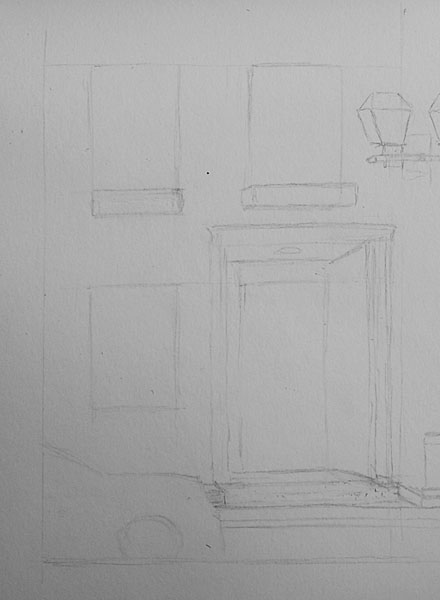
2014-06-21deAuteuilResidencePencilTake a look at this preliminary pencil sketch.  You’ll notice that there is no detail.  It’s mostly about boxes but those boxes represent the windows and door of the building.  While drawing those boxes I paid close attention to their relative alignment and sizes.  I didn’t fuss over whether the lines were straight or the corners square as I was more interested in whether the two windows on the left were the same size (the third window is different) and to ensure that the windows would be lined up with one another when I drew them.  Notice that I also drew a few lines to represent the front of a car.  Here I was only interested in the windshield and hood angles, where the car sat relative to the bottom left window, and where the curb line met the front of the car.

Is this necessary?  Of course not.  In fact, Marc Taro Holmes just did a great blog post on using ink dots to organize a drawing.  I’ve used that method myself.  Still do.  But by using a pencil,  I end up with boxes that I can look at, compare to the building I was sketching, and, for me, it provides better visualization of how the sketch will look when finished.

Regardless of how you do it, the important thing, I think is that you do this sort of organizational step before you start your actual drawing.  Too many sketches are less than they could be simply because the drawing step was started too soon, leaving the sketcher to discover, major misalignments, a lack of space for a particular object, and other dilemmas that are easily avoided.

Another advantage of pencil use it that a pencil is a tool separate from my actual drawing tool.  By using it, it’s easier for my feeble brain to understand that I’m ‘organizing’, and not ‘drawing.’  It causes me to take the time to actually see the organization of my subject and causes me to organize it on the page.  Often, if I work directly with pen, I’m inclined to skip this step or rush through it too quickly.  Give it a try.  It might work for you in the same way.

In any case, here’s the result after I add ink.  Once again, the pencil lines are so light (I increased the contrast for the post) that there was no need for an eraser of any kind.

2014-06-21deAuteuilResidence_sm

Stillman & Birn Alpha (9×6), Pilot Prera, Noodler’s Lexington Gray

 

Quick Sketching My River

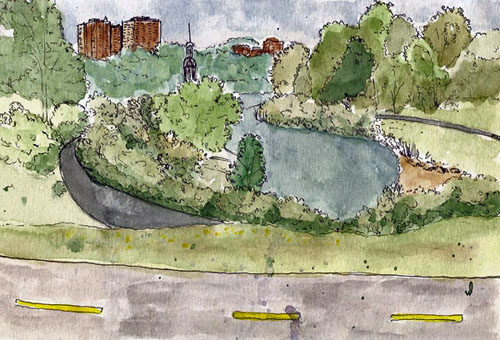
Yesterday was the day before the official beginning of summer and so, wearing shorts and a t-shirt, I headed out on a long walk and sketching session.  The sun was shining and I was whistling a happy tune.  Ok…ok… so I wandered into writing the opening for a musical.  Suffice it to say, it was a nice day.

But as I walked I noticed the clouds moving in.  I noticed the winds pick up.  I noticed my happy tune whistling had stopped.  I decided to sit on a fake log chair along my river and sketch a bit.  I also noticed that I was bordering on being cold and that I would need clips to keep the sketchbook paper from rattling in the wind.  So much for a summer day.

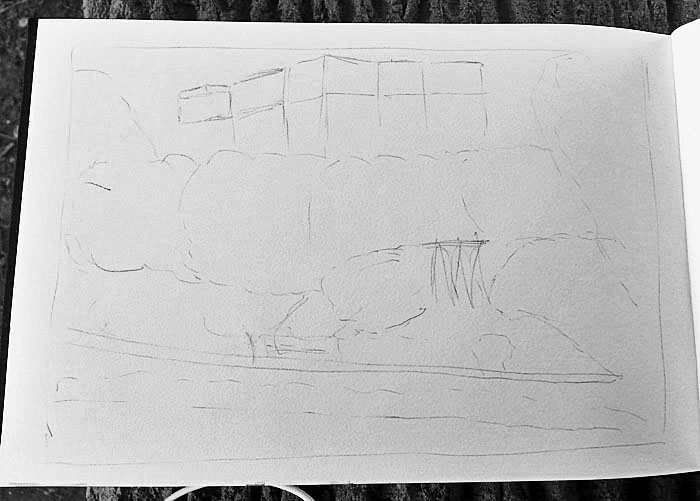
I’ve received a couple emails asking me what, exactly, I do with a pencil as a precursor to my ink drawing so I decided to try to illustrate the couple ways I use one.  Here is one of them.

This sketch was to be a large-scale, for me, urban nature sketch so I started with a very lightly drawn bunch of scribbles just to locate the various bushes, river, and building.  I shot a photo of the pencil layout with my cell phone and later manipulated the heck out of it to get the lines dark enough so you can see them….kinda.  This pencil work took 20-30 seconds.

2014-06-20 Pencil

You’ll notice that there’s no detail, not much more than vague lines that locate the various components.  All I’m thinking about is location and size of the various shapes and their relationship to one another.  By identifying these things I’m then free to concentrate on any part of the sketch without having to think about whether that part will connect to other parts.  For instance, because I know where both sides of the river will be in my sketch, I can draw the foreground plants, knowing where they should hide the river.

So out came the pens.  I started drawing the foreground using my TWSBI Mini filled with Platinum Carbon Black.  The rest of the sketch was done with a Pilot Prera and Noodler’s Lexington Gray.  No eraser was abused in the creation of this sketch.  Those light pencil lines just disappear behind ink and color.

I worked quickly and admit this is not my best work as, quite frankly, I was getting cold.  Yes, that’s right – cold – in middle of June.  Who’da thunk it.  Total time for this sketch was 23 minutes.  I kept track so I could report that as well.   I’m sure glad that tomorrow will be summer.  I’m getting tired of the cold.

2014-06-20Color_sm

Stillman & Birn Alpha (9×6), Pilot Prera and TWSBI MIni