Book Review: Urban Watercolor Sketching

Urban Watercolor Sketching coverThe complete title of the North American edition of this book is Urban Watercolor Sketching: A Guide to Drawing, Painting, and Storytelling in Color by Felix Scheinberger.  And if the recent flood of books about urban sketching and art journaling isn’t an indication that what we do has hit the mainstream, the title of this book most certainly let’s us know that “urban sketching” has become a marketing tool, like ‘new and improved.’

Why do I say that?  Because the only place that urban sketching is mentioned in this book is on the cover.  The author never references either urban sketching or storytelling.  Mr. Scheinberger wrote a book that would be better titled “Watercolor Sketching: The Effective Use of Watercolor in Sketching.”  And lest you think I’m faulting the author, the book was written in German and the original title translates to Watercolor for Illustrators (I think).  It ain’t his fault.  The sad thing is that I suspect the book would appeal to a wider audience if they’d put that on the cover rather than tried to fool people into thinking it an urban sketching book.

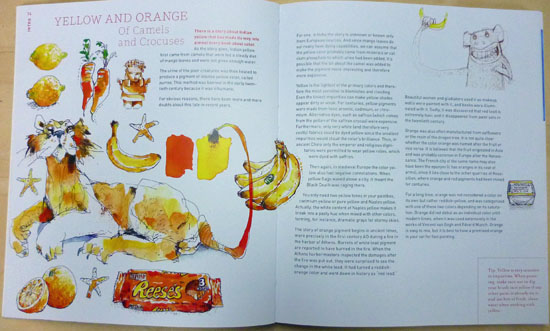
Urban Watercolor Sketching pages1

The book does a segment on each of the primaries and their compliments.

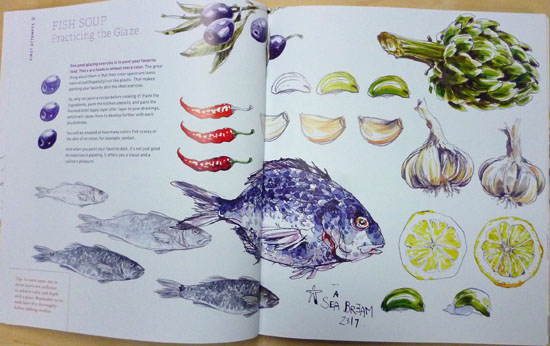
Urban Watercolor Sketching pages2

There are sections on how to use glazes.

Enough with the grousing over publisher folly.  This is a REALLY GOOD BOOK!  Felix Scheinberger is an illustrator of children’s books and his loose style, with both pen and watercolor are wonderful to behold.  The emphasis of the book is on color and its use.  It’s not a step-wise approach to watercolor techniques, but more of a mental toolkit for how to view and use watercolors.

In addition to discussions of color itself, Scheinberger talks about making decisions about color combination, using color sparingly, creating harmonies, atmosphere, and composition.  His discussion of materials assumes the use of single sheet or blocks of watercolor paper so brush talk revolves around that sort of presentation rather than small sketchbooks.  There is no discussion of pencil/pen, which allows him more space to discuss color philosophy and decisions.

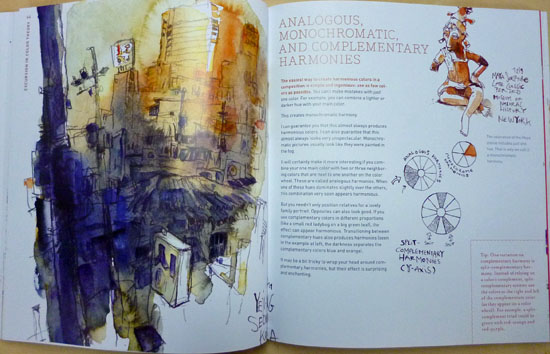
Urban Watercolor Sketching pages3

Color harmony is an important theme in this book

Urban Watercolor Sketching pages4

The other main theme of the book is how to loosen up the use of watercolors and use it sparingly.

The name of this book may be way off base but if you’re an urban sketcher you’ll still find much that will float your boat.  Scheinberger’s style is very loose but he turns his art towards urban landscapes quite often so his advice applies to these subjects.  I never sketch outside of a sketchbook and yet I thoroughly enjoyed this book and highly recommend it.

Sketching At The Quebec Aquarium

Claudette, Fernande and I headed to the Quebec Aquarium because predictions were for rain.  This is an ideal sketching venue when weather is suspect because there are both indoor and outdoor sketching available.  As it turned out, the weather was pretty nice so we all stayed outdoors.

I started my day with a sketch of the largest building complex.  It was a nice building scene and I could sit in the shade of a large ash tree.  I had fun sketching the tall, large-leaf plants I was looking over from my tripod stool view.

Quebec Aquarium building complex

Stillman & Birn Alpha 10×7, Pilot Falcon, Platinum Carbon Black

We met for lunch at a picnic bench in the kid’s playground and compared sketches.  Then we talked about their sketching sessions while I was in Ottawa and I told them about my sketching in Ottawa.  I really enjoy this part of urban sketching.  There’s just nothing like the camaraderie among sketchers.

We split up again and I did a bit of wandering.  There are several ponds on the grounds and I found a water lily that grew in just the right spot for me to sketch and so I sat down and did just that.

water lily

Moleskine watercolor book (5×3), Pilot Falcon, Platinum Carbon Black


Practice Makes Perfect… and Fun

I’m not a sports guy.  I don’t watch football, basketball or hockey.  Heck, I don’t even know the rules of hockey.  But baseball…ah…baseball.  I’m a sucker for baseball.  I do limit my watching to one team – the Toronto Blue Jays, but that’s 162 x 3 hours of TV watching from April thru September.  Lots of potential sketching practice time.

While I watch these games I use my laptop to keep up with email, write blog posts, and read other people’s blogs.  I also sketch, and sketch, and sketch.  Often I’ll just practice cross-hatching, drawing long, straight parallel lines, or testing pens.  I draw countless ellipses, draw odd shapes, shading them into 3-dimensional existence, and anything else I can think of.  Not only is it fun, it’s how I’m learning to draw.  I don’t think one can learn to draw by drawing final, formal sketches any more than a person learns to play piano by playing piano concertos.  You’ve got to practice the various parts of art, the movements of the hand, the proportions of things.

I’ve always done this sort of practice on photocopy paper, ultimately throwing the results away.  But I’ve bought a cheap Strathmore, 400 series “Drawing” book for this practice.  The other night I put my laptop next to me on the sofa, did an image Google search on “people” and started quick-sketching people from the images.  I thought I’d share the results.  Certainly nothing special and evidence that I need the practice, but it might be something you want to try as it’s lots of fun and certainly good practice.

Done with a Tombow 2558  HB pencil

Done with a Tombow 2558 HB pencil

Monologue Is Coming To America

Monologue1Monologue is a sketchbook/journal company based in Singapore but they’ve just established a beachhead in North America in the form of a website.  They sent me examples of their sketchbooks for review and I’ve been using them for a couple weeks.  I thought it time to talk about them here.

They produce several sketchbooks and a many journals but for purposes of sketching, the choices come down to these three “sketchbooks.”  If you use lined journals, however, I encourage you to peruse their website.

All three sketchbooks contain 140gsm (~90lb) Italian paper.  The paper surface is similar to Stillman & Birn Alpha paper if you’re familiar with those sketchbooks.  I’ve found that it handles watercolors fairly well and that it handles my fountain pen inks just fine.  Ballpoints, gel pens and pencils work well also.  In general, I give the paper high marks, though it’s not for those wanting to work wet-in-wet with big sloppy washes.  You can’t scrub this paper, though, so expect limited ability to lift pigments as it generates pills quickly.

Hardcover and softcover sketchbooks

I’m going to talk about the hardcover and softcover A5 and A6 sketchbooks separate from the larger one as their design is so different.  These smaller books can be purchased with either a hardcover, similar to a Stillman & Birn or Canson sketchbook, or as a softcover, more like a Moleskine.

Both books in either A5 or A6 size come with 64 sheets (128 if you use both sides for the math-challenged among us).  The hardcover books have a small cover overhang while the softcovers have no overhang and the corners are rounded.  Both can be made to lay flat – a big plus.

Personally, in small sizes I very much prefer the softcover, no overhang format, as it makes the overall footprint smaller and easier to shove into my pocket or art bag.  I noticed that the website indicates that the hardcover sketchbooks are available in a variety of colors (big plus) while the softcover is only available in black.  Both covers are high quality and the A6 softcover that I’ve been using is holding up nicely to the abuse I’ve foisted upon it.

In my opinion, both sketchbooks suffer from a fatal flaw, at least for me.  The pages are perforated.  Monologue believes we sketchers want to remove pages from our sketchbooks and while that may be the case on occasion, a more general concern is that our pages don’t fall out.  The odd thing is that Monologue doesn’t feel this same ‘feature’ should exist in their lined journals.

To date I haven’t had any pages fall out but there are other issues associated with perforations.  The perforations make it very difficult to do two-page spreads as many like to do.  Also, I found that a decision must be made whether to use the whole page or to exclude the portion that would remain in the book if you did remove the page.  There are esthetic dilemmas in either case (click on photo to see a larger view):
Using the entire page, drawing over the perforations
Using the entire page, drawing over the perforations

Limiting the sketch to the non-perf portion of the page

Limiting the sketch to the non-perf portion of the page


The most annoying part of the perforations, however, comes when you want to turn the pages of the book.  The pages bend at the perforations rather than turn as an entire page, which means you’ve got to be very careful when doing the simple operation of flipping through your sketchbook.  In short, if you like perforations (is there anyone?) then you’ll like this ‘feature.’  For me it’s a deal-breaker.

In conclusion, these sketchbooks have a lot going for them if the perforations aren’t a problem for you.  The price is certainly right (A6 soft-cover sells for $6.99).

Large, gorgeous A4 sketchbook

Monologue 9x12, Pilot Falcon, Platinum Carbon Black

Monologue 9×12, Pilot Falcon, Platinum Carbon Black

This book is a a stunner.  It features a fabric cover that feels almost like velvet and there’s a nice design embossed on the front cover.  The inside features a blue lining. The cover can be folded back entirely to reveal a large pad of 9×12, 140gsm paper that’s glued into the cover.  I did this sketch in it and it performed well for me.  I would absolutely love this sketchbook if the paper were spiral bound so I could flip it back along with the cover.

But therein lies the rub.  Once again the Monologue people believe that sketchers want to tear the pages out of their sketchbook as they work and this book is designed with that in mind.  The website suggests that this book has perforated pages, though mine does not.  You can just separate the pages from the fabric binding they are glued to (not sewn).  The paper is bound with a cloth binding along the top and the idea seems to be that you’ll use it like you would a legal pad, tearing out the ‘used’ sheets, leaving the beautiful binder for the recycle bin I suppose.  I confess I’m not smart enough to understand this.

Monologue7Possibly, if you were to use this sketchbook in a studio, you could flop the binder open on a desk, draw on the pad side and keep the sketches you create in the book.  But if you’re on the street, you face the problem of pages either hanging in the breeze or bent back as in the photo.  In either case, the weight of these pages cause the drawing surface to bend and curve upward.  Yes, you can pull it down but this places considerable strain on the glued edges of the paper.  A rubber band might hold it flat enough but the problem will get worse and worse as you progress through the book as more and more of the weight of the book will reside in those bent-over pages – unless the used pages are either removed or fall out on their own.

Each of uses our sketchbooks in a different way but regular (mandatory?) page removal doesn’t seem to be one of them.  But if that’s the way you use your sketchbooks, by all means check out these new offerings from Monologue as in all other ways these sketchbooks are good value.



Sketching When You Have No Time

This is a topic that is discussed regularly.  For the most part it comes up because so many people claim they have no time to draw and those of us who draw spend lots of ink explaining that it’s easy to find time to draw.  I suspect those saying they have no time take those ‘explanations’ with a grain of salt and dismiss them as “well you may have time but I don’t.”

So I thought it might be interesting to start my own approach to this subject by saying that it can be hard to find time to draw if you define drawing as creating a masterpiece.  If you’re picky about what you draw and when, time may become an insurmountable problem.  It’s sort of like a pianist deciding that “playing” means a complete concerto.  But that same pianist sees a piano and they’re inclined to sit and play a few notes.   I’m hoping that maybe, just maybe, my recent trip to Ottawa will present a few solutions to the time problm and maybe loosen up the definition of an acceptable drawing.

Before I do this I want to point out that the value here, of ‘drawing’ or ‘sketching’, isn’t defined in terms of the finished product.  Value comes from the experience and fun of the doing.  That simple shift in perspective changes everything and opens the doors wide.

Most of what you’ll see here are quick sketches done in a cheap sketchbook that I wouldn’t normally scan or present them to anyone.  But I had fun doing each one and each of them gave me joy and experience.

Ottawa trip conditions

This was a very busy trip for me.  It wasn’t a “let’s go sketch in Ottawa trip.”  Rather it was a “let’s move our daughter to Ottawa” kind of trip.  Our daughter was moving away for the first time so lots of emotions were heaped on top of the pragmatics of such a move.  There was no situation where I was alone and had large blocks of time to sketch.  I did sketch, however, and the thing that allowed it was having a pen and sketchbook in my pocket at all times.  In this case I carried a pencil, pen, and a small Monologue sketchbook.a

Drawing while resting

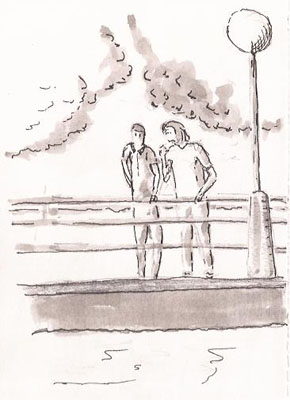
2014-09-01RideauQuickSketchMy wife and I went for a walk along the Rideau Canal the morning after we’d moved my daughter into her new apartment.  We needed to decompress a bit and the relaxing walk did us a lot of good.

At one point my wife decided we should sit a minute and I always do what my wife tells me.  We sat.  There were two people looking at the canal on the other side, so I pulled out my sketchbook and, in less than a minute, I drew this quick sketch of them.  It’s not very good but it’s useful to try to capture a subject in a few lines, even if they’re wavy lines (grin).

aaaa

Sketching at night

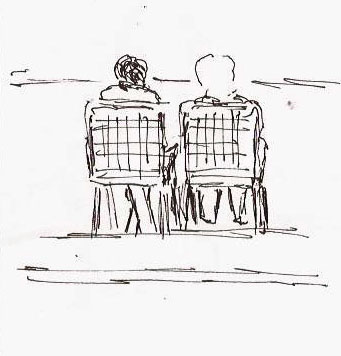
2014-09-01nightsketching1Beginning drawing classes love to have people who can’t draw try to draw without looking at their paper.  This is supposed to be good for you.  I don’t believe it for a second, but once you can draw a little bit, this exercise can be valuable.

2014-09-01nightsketching2

After spending the day moving stuff into an apartment and dealing with separation anxiety issues, my wife and I found ourselves sitting in a boring hotel room.  We decided to walk to get some coffee.  She suggested that we walk to the Parliament building and enjoy the evening drinking our coffee plein air.  When we got there we found out that the great light show they do every night was going to start in half an hour, as soon as it got dark enough.  We decided to stay to see it and so just relaxed and chatted, sipping coffee on a wonderful summer evening.  This moving stuff wasn’t so bad after all.

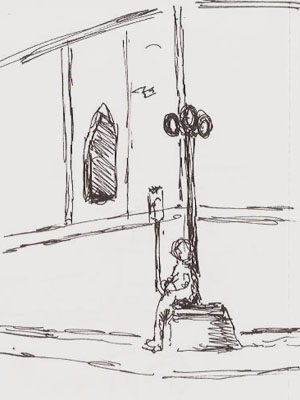
2014-09-01nightsketching3As the show was about to begin we moved to a spot where we could sit on a curb (hard for an old man) and watch the show.  It was dark by then but we still had to wait a while for the show to begin.  I got the crazy idea that if the art world thought I could draw without looking at my paper, maybe I could draw the vague forms moving around in the dark without seeing my paper.  I’ve never been accused of being sensible.

I got out my TWSBI Mini, my Monologue A6 sketchbook and started drawing.  These are three of the sketches done in the dark.  I did hold the book up over my head once in a while as it allowed me to catch a bit of reflected light from the street to look at my progress.  Then I’d stick the pen tip on the paper and return it to drawing position so I could continue drawing.  It was so much fun I think I’ll try it again sometime.

Sketching time?

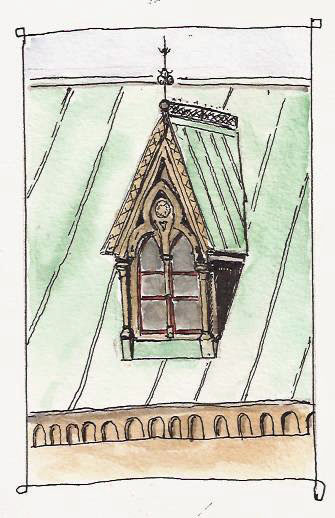
2014-09-02ParliamentGableOur daughter had to spend some time at the university picking up stuff, signing papers, etc.  We were “free” for a couple hours.  We made a disappointing visit to an art supply store that was, well, short of supplies in my opinion.  So we decided to wander around the Parliament grounds with the thought of sketching.  It would be tough for me to do one of my “takes forever” sketches so I had to choose something that wouldn’t take a long time… maybe a piece of something.  I chose to do one of the gables on the original Parliament building (built in 1883 I think).  Perspective suffered due to the rush but dems da breaks.

Then we went back to the Rideau canal where I managed to spend half an hour drawing one of the modern buildings which will be made famous by our daughter attending her classes within its walls.

Stillman & Birn Alpha (10x7), Pilot Falcon, Platinum Carbon Black

Stillman & Birn Alpha (10×7), Pilot Falcon, Platinum Carbon Black

These last two sketches consumed less than an hour of time and that time was hard to come by.  For the rest?  Easy peasy if you have a sketchbook and pointy device with you.  Are the quick sketches worthy of showing to your friends?  Not sure but they were just as much fun to do as these last two and isn’t that why we sketch?