Writing At The Coffee Shop

It’s been so cold here lately that I’ve been reluctant to go walking.  The other problem, of course, is that ‘walking’ is more like slipping and sliding here right now.  So I’ve been doing some writing, trying to make some progress on that front.

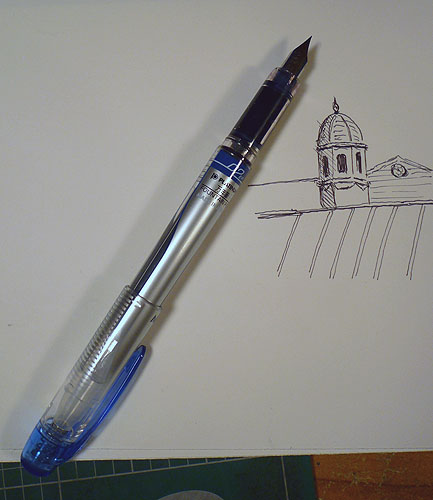
2015-01-21brulerieBut I can only stay at home so long before I start going nuts so I went to a nearby coffee shop to work.  I grabbed a table in the back corner of the place and a café allongé and went to work.  After a couple hours I took a break from editing and decided to give my new Sailor calligraphy pen a test run.  I quickly sketched (3×5) the view I had, which wasn’t great because I purposefully had hid myself from most of the clientele.  This pen is quite different from my Hero calligraphy pens and Tina Royama claims it’s easier to control.  I think she’s right but it will take a bit of getting used to, as this sketch illustrates.

2015-01-20crossingguard

I got another coffee and moved to a place by the window and worked for another hour. I saw this woman working as a crossing guard in the bitter cold.  The sad look on her face got my attention and I devoted a bit of ink to capturing her plight.  I shared those feelings as I’m an Arizona boy and Quebec winters are not something I take to with great fondness.

I looked around and there was a guy sitting with his back to me.  He was wearing a backwards baseball cap.  He’d taken his coat off and was wearing a t-shirt.  For some crazy reason this stuck me as odd, given that everyone else was wearing long sleeves, sweaters or coats.  Internally I chuckled and I drew him as though it weren’t -30 outside.  I drew him in his t-shirt, backwards baseball cap and shorts.  I guess I was hoping it would make me feel warmer.

2015-01-21guy

This sketching adventure involved about three hours of writing/editing and less than ten minutes sketching but it was better than nothing (grin).


Pen Review: Platinum Preppy 02

open

I’ve always been a fan of the Platinum Preppy.  There is no better bang for the buck ratio in the fountain pen world in my opinion.  For a street price of $3-4 you get a fully-functional, cartridge-fed fountain pen that can even be upgraded with a converter if you so desire.  It comes in half a dozen colors and each comes with a matching Platinum ink cartridge.

One of the ironies of life is that this inexpensive pen is one of the most reliable pens I own, and I own a lot of pens.  Until now, they’ve come in 05 and 03 nib sizes and I’ve always favored the later because I tend to work small and thus love fine-nib pens.

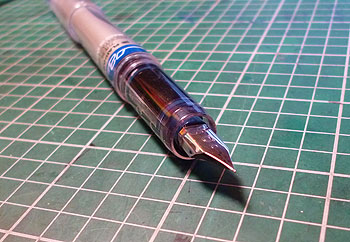
nibSo, when Platinum released an 02 version of this pen I had to try one.  It arrived as part of an order from Jet Pens with one little glitch.  Platinum’s cartridges are nice as they use a small metal ball to seal the end.  When you insert the cartridge, the ball is shoved into the cartridge and acts as an agitator for the ink, one of the things that makes these pens so reliable.

But guess what happens if you put water-based inks in a -30C environment which was my mailbox.  Yep…the ink freezes, expands, and the little ball is shoved out the end.  Fortunately, it was washable ink and so an easy clean up.  So, my tests with this pen were done with J. Herbin Perle Noire ink rather than with the Platinum blue that comes with it.

closed

The appropriate review word for this pen is WOW.  If you like fine pens you will like this new Preppy 02.  If you don’t, you won’t.  It is just a bit finer than a Micron 01.  Like other Preppy pens it is smooth for such a fine nib and I spent half an hour just making hatch marks and little doodles with it.

This pen has a fancier paint job than do the 03 and 05 versions.  I’m not sure if this is a remake of the Preppy line and/or if we’ll see this scheme on the rest of the Preppies soon.  It is the case that the 02 is more expensive than the 03 and 05, at least right now.  Jet Pens currently sells it for a whopping $4.45, or the cost of a decent sized latte at Starbucks (grin).

quicksketch

Frustrated January Sketcher And Other Stuff

I apologize for not posting much since Christmas.  I’m full of excuses if that will help.  You see, while most folks get to return to normal after January 1st, my holiday season is in full swing.  My daughter was home for the holidays.  Both Chantal and Jodie have birthdays in the first half of January and we just returned from Ottawa.  Oh…and it’s VERY cold, so for a street sketcher it’s a tough time of year.

I looked at my total sketching experiences from my Ottawa trip and two things happened.  First, I sighed and did a mental ‘woe is me.’  Then it occurred to me that it might be worth mentioning a couple things about the result, so here it is.

2015-11-OttawaClearly this isn’t a post about my great art.  Rather, I want to talk about some philosophical and pragmatic things that these two pages represent.  You see, this is a brand-spanking new Moleskine sketchbook.  Now I’m not a fan of these sketchbooks for ‘real’ drawing but I had the opportunity to get one cheap and so it’s going to serve as my daily ‘quick-sketchbook.’  I carry one of these with me at all times and not stuffed away in my man-bag (which holds my regular art stuff) but rather in my pocket, with some sort of quick-sketching pointy device tucked away with it.  It can be brought out in seconds and is often returned a couple minutes later with a new sketch between its covers.  I started doing this about two years ago when my buddy Yvan Breton convinced me of the power of such an approach.

Two things occurred when I started carrying such a sketchbook.  The first, and most important was that I started doing a LOT more sketching.  In the past couple years I’ve filled about 20 of these little 3×5 or 4×6 sketchbooks in addition to my regular sketchbooks.  Most of the pages are filled with quick sketches, though sometimes I’ll do something more complete.  No matter how you slice it, that means a lot more sketching fun and sketching practice and I can do it when no other kind of sketching is possible.  The other thing that has happened is that my ability to see shapes quickly has improved immensely and it allows me to be more loose with my line work than is my typical style.

The sketch on the right is typical.  I was sitting in a restaurant with my family and we were waiting for our food to arrive.  This woman was standing at a bus stop across the street.  I took out my sketchbook and pen, a Uniball Vision, and quickly sketched her.  I doubt that it took two minutes, which included having to wait for a large truck that blocked my view as it waited for a light.  Then the book went back in my pocket and I was ‘back’ with my family.

The left page is also interesting as it shows my lack of respect for the space so many treat as hallowed ground – the pages of a sketchbook.  When you worry about whether every page is worthy of posting on Facebook, you will lose many opportunities.  My small sketchbook is a place where ‘who cares’ rules.

In this case I’d started a sketch while leaning against the wall of my daughter’s apartment.  I was looking out the back window and had started drawing a nearby building.  I was using a Zebra 301A ballpoint.  It was announced by my boss…err..wife, that it was time to go so the book went into my pocket.  We were headed for Ikea.

We hadn’t been in an Ikea in a decade and acted like farmers in a big city for the first time.  We ate meatballs and wanted to buy everything in sight.  Realizing that we had to write numbers of stuff we might want to buy, I pulled out my Moleskine Sketchbook and started writing.  Would you do that with your sketchbook?  It’s to your advantage to be willing to do so as otherwise you won’t start a lot of sketches because you won’t feel you have time to ‘finish’ or ‘do the sketch justice.’  We did buy that kitchen island, by the way, and hauled it back to Quebec.

Now, do you need a Moleskine sketchbook for this?  Heck no, and in fact I’d advise against it.  The paper is ok for pen or pencil but it stinks for watercolor isn’t necessary for pen, and they’re ridiculously expensive.   Most of my small sketchbooks are 3×5 or 4×6 sketchbooks that I’ve bought at our dollar store, though they typically cost me $2.


Colder Than Mars, They Said

Have you noticed that the news exaggerates everything?  They no longer report.  Rather, they compete with Downton Abbey and football games for viewers and will do everything and anything to make their program entertaining.  I expect that soon, Captain America or Thor will replace Wolf Blitzer as anchor of CNN.

It’s really sad.  The week we were told about how Canada was “colder than Mars” a couple days ago.  While it’s true that, for a period of a few hours, a part of Canada was colder than where NASA’s robot was on Mars, but Canada didn’t get to -200C when the sun went down like it does on Mars.

Heck, we only got down to -40C and it had warmed all the way up to -36C by the time I got the bright idea to walk to the museum to meet my buddies for a sketching session.   For those who are Fahrenheit-challenged, -40C is -40F.  Warmer than Mars on a summer’s eve for sure, but still sort of cold by freeze your skin standards.

So off I went, the intrepid sketcher, walking as fast as I could on a 40-minute walk to the museum.  A smarter sketcher would have just hopped on a bus but no, I “needed the exercise.”

facehurtsBy the time I got there I realized that I’d been crazy.  I could no longer feel my fingers in spite of the heavy gloves I was wearing.  My face was on fire and the I was starting to think in terms of how much further I could walk before I’d fall over.

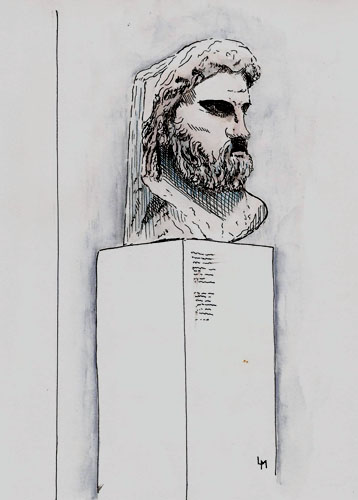
But I finally arrived…warmth.  Next problem was how to sketch when I couldn’t feel the pen.  I walked around for about 15 minutes before deciding to do a looser sketch than my typical approach, maybe as a result of Liz Steel’s course.  I sat down in front of the largest head in the Olympus display.  It’s at least two-feet tall and very impressive – more impressive than this sketch suggests.  My fountain pens were really cold so I used a Uniball Vision Fine hybrid gel pen, adding a hint of color with Faber-Castell watercolor pencils.  Of course, it was drawn in a Stillman & Birn Alpha series sketchbook (10×7).

We took a break, had some tea, and then did a bit more sketching before calling it a day.  I took the bus home, a nice, warm bus.

2015-01-08Olympus1


Book Review: Sketch by France Belleville Van-Stone

Sketch - France Belleville-Van Stone

Sketch – France Belleville-Van Stone

I got into sketching at the right time as we’re clearly living in a golden age for those of us who like wandering around sketching our towns.  The popularity of journal sketching has exploded as more and more people realize that the classic ‘you aren’t talented enough for art’ stuff is a myth and the number of artists willing to help those of us trying to learn is extraordinary.  How did people learn anything before the internet?

What’s lagged behind is the art world.  Frankly, most still don’t get it.  They still believe that a sketch is something you do in preparation for a formal painting.  While architects, illustrators and animation types fill sketchbook after sketchbook, fine artists don’t even own one.  Even that is changing.  With any luck at all, the local art supply stores will catch on as well but for now, I find that for most of my gear I have to go online.  The choices of materials, however, are growing daily.

With all these things going on, it’s hard to imagine better evidence for a sketcher revolution but there is one.  It comes in the form of a steady stream of books on sketching that are hitting the market like fresh corn in September.  When I started sketching, the single “urban sketcher” book was Gabi Campanario’s Art of Urban Sketching.  But in the past couple years I’ve bought at least a dozen books on quick-sketching and urban sketching and there are more on the way.

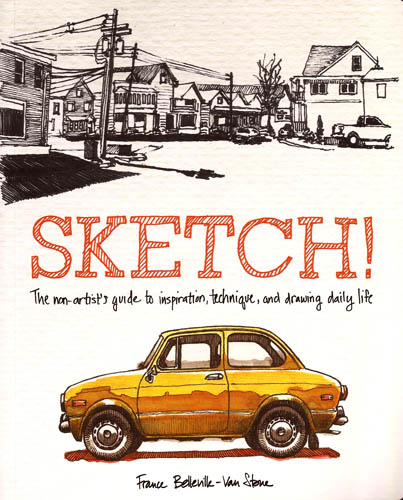
And so, when France Belleville-Van Stone’s book Sketch was released I very nearly passed on it, assuming it was another ‘here’s how to sketch’ book.  I’ve followed her blog for a long time and enjoy her sketches a lot, and so in a moment of weakness I pressed the button on Amazon.

The book’s arrival made it clear that I would have made a big mistake by not buying her book.  The reason is hidden, not so subtly, in the subheading of the book – Sketch: The Non-artist’s Guide to Inspiration, Technique, and Drawing Daily Life.  This book is about how to think like a sketcher and she provides inspiration and ideas for how to approach sketching that are often sidestepped by those more concerned with telling you what paper and pen to use.  Couple this with the high quality of the writing and you can’t help but enjoy it.  While France’s sketches are fantastic, this is one art book where the words are an important part of the package.
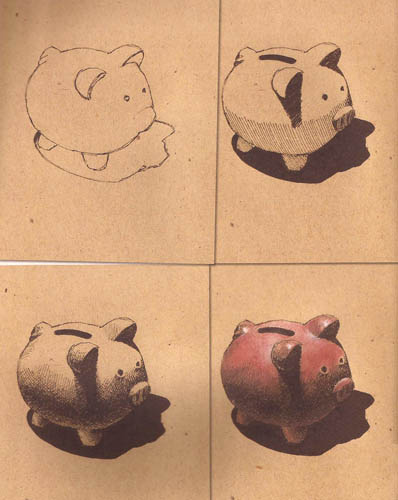
2014-12-29pigFrance begins by addressing the nonsensical use of the word ‘talent’ by those who suggest they don’t have any.  I won’t try to recap this section except to say that both prose and insights are fantastic and put a smile on my face.

This introduction leads to chapters on materials and techniques and I love both for what is not there.  There’s no attempt to cover all the possibilities and, in fact, France says she isn’t doing that and that she’s talking only about the materials she uses.  Similarly, while France is a seasoned artist, she opens here techniques section with “There is a bit of irony in me attempting to write a chapter on techniques, knowing my last drawing lesson dates back to elementary school….”  In truth, France provides plenty of techniques in this book but not in the traditional form.  There are no sections on perspective, color theory, or the rest of the stuff you can find in any intro book on drawing.  The single exception is that she does spend some time on approaches to hatching and since that’s such an important facet of her own sketching style, this makes perfect sense.

What France gains by not filling the book with stuff you can find in any drawing book is a lot of space to talk about strategies and tactics of a sketcher.  How do you deal with drawing environments that restrict the time you have to draw?  How do you redefine “complete” when it comes to your sketches?  How might different definitions affect your approach to different subjects?

She talks about completely relinquishing the need to complete anything at all?  Here she discusses one of my favorite dichotomies – being motivated by the process of art rather than products of it.  She eloquently discusses how liberating it is to shift away from emphasis on the products, placing all of it, instead, on the fun that comes while you’re doing art.  Ever drawn something and left it on a table at a restaurant?  I have and as France describes such a though is very liberating.

The book contains a chapter on digital art, an approach that for me, misses the whole point of drawing, but then I’m a guy who likes, more than anything, the feel of a pen moving over paper.  But a good case is made for using tablets as drawing devices, though France admits that this isn’t a replacement for what are now called “traditional approaches.”

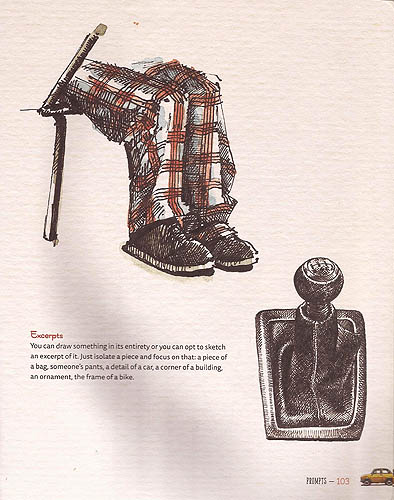
2014-12-29excerptsA big surprise to me were the last forty pages of the book.  Titled simple “Prompts”, I assumed this was yet another attempt to feed a list of ‘motivators’ or whatever they’re called to people who can’t see the multitude of things to draw that exist in everyone’s daily life.  Yawn…

But I was wrong…or right…no wrong.  It is a list that walks you through the alphabet, providing subject matter for each letter so in that sense I was right.   In the case of A, for instance, France uses Animals and Airports and talks about the value of sketching animals and the rich environment that is an airport.  But for other letters (eg -E) she’ll talk about the potency of doing Excerpts, discussing how sketching pieces of things is fun.  In each  case she provides great examples from her own work and I thoroughly enjoyed this section, and now more ideas and more varied perspectives on how to choose my subjects.

In the end, this is a wonderful book for anyone interested in sketching what’s in front of them and/or simply likes France’s art as much as I do.  Sketch: The non-artist’s guide to inspiration, technique, and drawing daily life is brilliantly written, making it more fun to read than many art books.